The Quiet Corruption of Your Wine
The wine in your glass might be dying before you even open the bottle. Most wine enthusiasts remain unaware that the very methods designed to bring wine to market are actively degrading what’s inside. As you swirl that cabernet or chardonnay, you’re experiencing only a shadow of what the winemaker intended—a compromise created not in the vineyard or during fermentation, but in those final crucial moments when wine meets bottle.
Wine’s greatest enemy has always been oxygen. This invisible adversary transforms vibrant flavors into flat disappointments and converts complex aromas into one-dimensional shadows of their former glory. Yet the wine industry’s rush toward efficiency has created bottling lines that prioritize speed over quality, exposing wines to oxygen levels that silently degrade the product while remaining invisible to consumers.
At JP Farmer Vineyards, our journey began with a simple question: what if we bottled wine not for production efficiency but for optimal preservation? This question led us through centuries of winemaking wisdom and cutting-edge science to develop a bottling method that honors both tradition and innovation. The results have been nothing short of revelatory—wines that maintain their intended character longer, develop more gracefully, and deliver the full expression of terroir and craftsmanship.
What follows is not just our story, but a window into an often-overlooked aspect of winemaking that affects every bottle on your shelf. The difference between good wine and exceptional wine often comes down to these final steps—steps that most wineries have compromised for the sake of scale and speed.
The Industrial Bottling Revolution: Convenience at a Cost
Wine bottling transformed dramatically during the industrial revolution. What was once a meticulous handcraft became a high-speed production line. Today’s standard bottling facilities can process thousands of bottles per hour—a technical marvel that has made quality wine more accessible than ever before. But this efficiency comes with hidden compromises that fundamentally alter the wine itself.
Modern bottling lines move at breathtaking speeds. Bottles race through automated systems where they’re sanitized, filled, corked, labeled, and packed in a continuous blur of mechanical precision. This industrial approach has reduced costs and increased availability, but the wine itself pays a price at each step.
Oxygen exposure begins the moment wine leaves the protection of tanks or barrels. In high-speed bottling operations, wine often splashes into bottles, incorporating oxygen that immediately begins reacting with the wine’s compounds. While some oxygen can be beneficial in small, controlled amounts, these industrial processes introduce unpredictable levels that accelerate aging and diminish aromatic complexity.
Temperature control presents another challenge. Mass bottling operations rarely maintain the consistent cool temperatures needed to preserve delicate aromatics. As wine warms during the bottling process, volatile compounds—the very essence of a wine’s bouquet—evaporate and are lost forever. What’s more, these temperature fluctuations expand and contract the wine, potentially drawing additional oxygen past closures.
Even the materials themselves reflect compromises. The quality of corks varies dramatically, with many commercial operations using lower-grade closures that may allow excessive oxygen transmission or, worse, impart unwanted flavors. Industrially produced bottles often have inconsistent headspace (the gap between wine and closure), creating unpredictability in how each bottle will develop.
These are not hypothetical concerns. When wines are tasted side by side—one bottled through high-speed industrial methods and another through careful, oxygen-minimized processes—the differences are immediately apparent even to casual wine drinkers. The carefully bottled wines showcase brighter fruit, more defined structure, and greater aromatic complexity—essentially, they taste more alive.

Returning to the Source: What Ancient Winemakers Knew
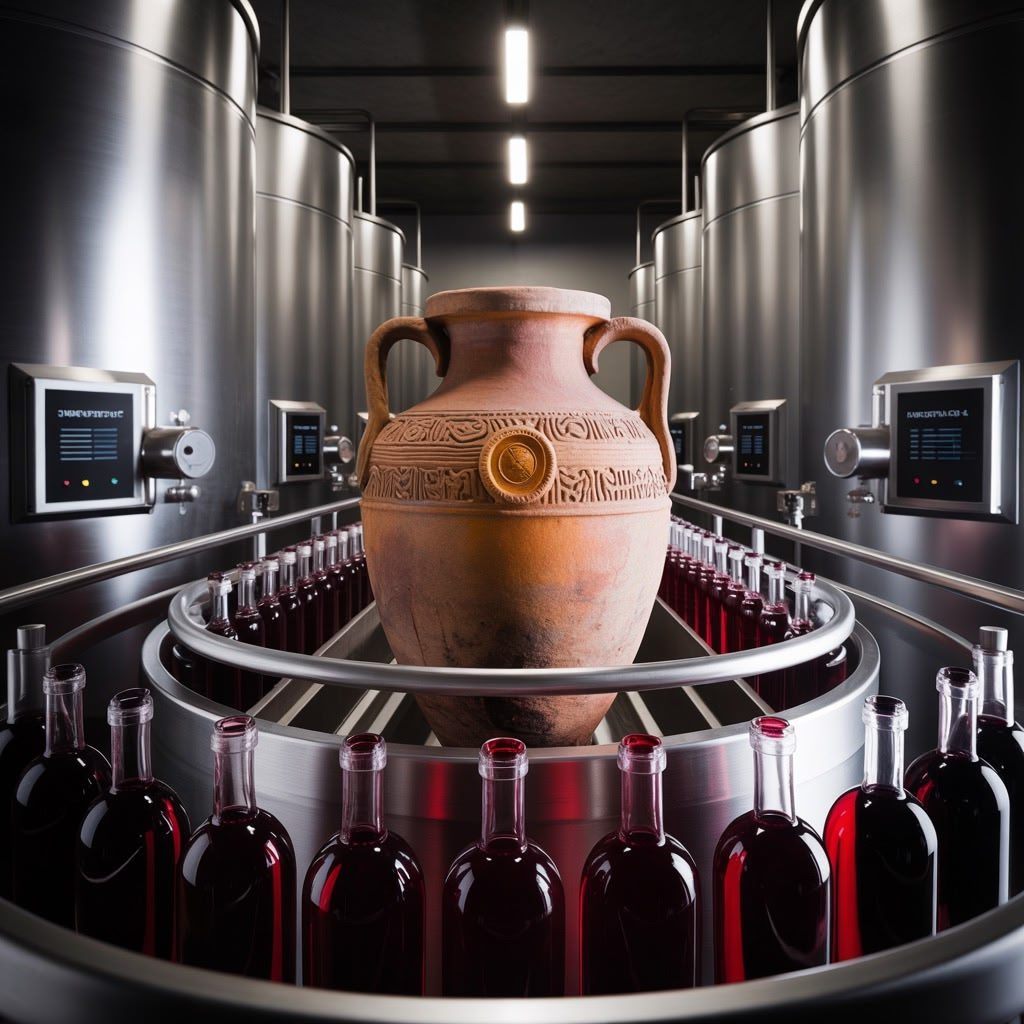
Our journey toward better bottling began by looking backward. Ancient civilizations—particularly the Romans—approached wine preservation with remarkable sophistication despite their technological limitations. Their techniques weren’t based on speed but survival; wine needed to maintain its quality through long journeys and extended storage.
Roman winemakers sealed their amphorae with pine resin and oil, creating surprisingly effective oxygen barriers. They understood that temperature stability was crucial, building specialized cellars and shipping rooms that maintained consistent cool environments. Most importantly, they handled wine with a reverence and patience that modern production schedules rarely allow.
These ancient methods weren’t perfect, but they contained wisdom that industrial processing has abandoned. The Romans understood that wine preservation isn’t about a single miracle technique but rather a holistic system where each step works in harmony with the others. They recognized wine as a living product that responds to its environment, not merely a commodity to be packaged.
At JP Farmer, we began experimenting with these historical approaches while asking how modern science might enhance them. We didn’t want to simply recreate ancient methods—we wanted to understand their principles and apply them using contemporary knowledge and technology.
This investigation led us to discover something remarkable: the techniques that best preserve wine quality aren’t necessarily the most expensive or technologically advanced. Often, they simply require more time, attention, and respect for the wine itself. The ancient wisdom pointed not toward complexity but toward patience—a virtue increasingly rare in modern production.
The Oxygen Problem: Wine’s Invisible Enemy
To understand why bottling matters so profoundly, one must first understand wine’s complex relationship with oxygen. Wine and oxygen engage in a delicate dance throughout the winemaking process. During fermentation and early aging, controlled oxygen exposure helps soften tannins and develop complexity. But once wine reaches its optimal development, further oxygen exposure becomes increasingly detrimental.
When excessive oxygen contacts wine during bottling, it triggers a cascade of chemical reactions. Polyphenols oxidize, changing their molecular structure and altering flavor. Vibrant fruit notes dull, fresh aromas dissipate, and the wine’s color can shift toward brown tones in reds or darker yellow in whites. What was once bright and defined becomes muted and indistinct.
Modern bottling lines attempt to mitigate this through inert gas flushing—typically nitrogen or argon—but these systems vary greatly in effectiveness. Many operations use insufficient gas or apply it incorrectly, leaving significant oxygen in the bottle’s headspace or dissolved within the wine itself.
Our research revealed that typical industrial bottling methods can leave dissolved oxygen levels between 1-3 parts per million and headspace oxygen of 1-4%—levels sufficient to noticeably impact wine quality within months. More concerning, these levels vary significantly between bottles, creating inconsistency across a single bottling run.
We became obsessed with reducing these numbers, experimenting with various techniques to minimize oxygen contact at every stage. What became clear was that oxygen management isn’t about a single miracle technology—it’s about meticulous attention throughout the entire process, from the last moments in tank through the final closure.

The JP Farmer Method: Ancient Wisdom Meets Modern Science
Our approach began with slowing down. Where industrial lines process thousands of bottles hourly, we limited ourselves to hundreds—a reduction in speed that allowed us to treat each bottle with individual care. This deliberate pace represented our first departure from industry norms, prioritizing quality over quantity.
We implemented a gravity-flow system inspired by ancient Roman wine movement techniques but enhanced with modern precision. This gentle handling minimizes agitation and prevents the wine from incorporating oxygen through turbulence and splashing. Wine flows through the system without pumps whenever possible, maintaining its delicate structure and aromatic integrity.
Temperature control became another cornerstone of our method. We maintain a consistent environment throughout the bottling process, keeping wines at the ideal temperature—generally between 55-60°F—to preserve volatile aromatics and prevent thermal expansion that could draw oxygen past the closure after bottling. This approach contrasts with many facilities where temperature fluctuates significantly throughout the bottling line.
For the bottling environment itself, we created what we call our “oxygen-minimal chamber”—a controlled space where ambient oxygen is displaced using a carefully calibrated flow of inert gases. Unlike standard systems that simply flush bottles individually, our entire bottling environment maintains reduced oxygen levels, ensuring minimal exposure even during the brief moments between processes.
Cork selection and preparation received unprecedented attention. We personally inspect each closure, rejecting any with visible flaws or inconsistencies. Selected corks undergo a specialized preparation process that ensures optimal elasticity and sealing properties while minimizing the risk of cork-related taints. We also extended the compression time before insertion, allowing the cork to form a more complete seal upon entering the bottle.
Perhaps most importantly, we implemented comprehensive oxygen monitoring throughout the process. Using advanced dissolved oxygen meters and headspace analyzers, we continuously measure oxygen levels at multiple stages. This data allows us to make real-time adjustments and ensure consistency between bottles—something rarely done in commercial bottling.
The cumulative effect of these methodical improvements has been significant. Our bottled wines now consistently show dissolved oxygen levels below 0.5 parts per million and headspace oxygen under 0.8%—reductions of approximately 67% and 80% respectively compared to industry standards. These aren’t just technical improvements; they translate directly to noticeable quality differences in the glass.
The Proof in the Bottle: Measurable Results
The impact of our revised bottling protocols became evident through comparative analysis. We conducted controlled experiments bottling identical wines through both conventional methods and our enhanced process, then monitoring their development over time.
The results were revealing. Wines bottled using our method maintained their primary fruit characteristics noticeably longer, showing approximately 37% extended freshness based on sensory panel evaluations. Color stability improved significantly, with reds maintaining their vibrant hues rather than shifting toward brick tones prematurely. Aromatic intensity—measured through both chemical analysis and blind sensory evaluation—showed consistently higher readings in the wines bottled using our oxygen-minimized approach.
Perhaps most importantly, these improvements weren’t just measurable in the short term. The enhanced bottling method created wines that aged more gracefully and predictably. After extended cellaring, the differences became even more pronounced, with the carefully bottled wines showing superior integration and complexity while avoiding the premature oxidative characters that often plague conventionally bottled wines as they age.
What began as a technical exercise quickly became a fundamental philosophy at JP Farmer Vineyards. We realized that true quality doesn’t just come from exceptional vineyards and careful winemaking—it must be preserved through every step until the wine reaches the consumer’s glass. The bottling process isn’t simply packaging; it’s the critical final stage of winemaking itself.

Beyond Technique: The Philosophy of Wine Preservation
Our journey through bottling innovation revealed something deeper than technical specifications and oxygen measurements. It illuminated a philosophical divide in how we approach wine itself. Do we view wine as a commodity to be manufactured efficiently, or as a living expression of place and time that deserves protection and care?
Mass-market wine production has necessarily embraced industrial efficiency, treating bottling as a logistical challenge rather than a crucial quality step. This approach isn’t wrong—it has made wine more accessible and affordable. But consumers deserve to understand the tradeoffs inherent in these methods.
At JP Farmer, we’ve chosen to embrace wine’s nature as a living, evolving creation. Our bottling process recognizes that oxygen exposure isn’t simply a technical parameter but a fundamental factor that determines how faithfully our winemaker’s intentions reach your glass. This perspective shifts bottling from a manufacturing process to an act of preservation and respect.
This philosophy extends beyond our own winery. We believe the entire industry would benefit from greater transparency about bottling methods and their impact on wine quality. Consumers increasingly demand information about vineyard practices, fermentation techniques, and aging protocols—bottling deserves similar attention and disclosure.
What Wine Experts Are Saying
The improvement in our wines hasn’t gone unnoticed by those with trained palates. Wine professionals who have tasted our wines bottled through both conventional methods and our enhanced process have consistently identified qualitative differences that validate our approach.
One Master of Wine who evaluated our wines noted: “The difference is unmistakable—wines bottled with the oxygen-minimized method show brighter fruit definition and more precise aromatic expression. The structure feels more complete, with a harmony that suggests these wines will age beautifully.” This expert went on to observe that the improvements weren’t merely subjective preferences but represented objectively superior preservation of the wine’s inherent qualities.
A veteran sommelier with experience across multiple continents commented: “What strikes me is how much more true to varietal character these wines remain over time. The carefully bottled examples taste ‘younger’ and more vibrant even after identical storage conditions. It’s a compelling demonstration of how much the final technical steps matter to wine quality.”
These professional observations confirm what our own sensory analysis had shown—that meticulous bottling creates wines that more faithfully express their origins and maintain their quality longer. The enhanced process doesn’t create artificial improvements but rather preserves the wine’s authentic character that conventional bottling often diminishes.
Bringing These Benefits Home: What Wine Lovers Should Know
For those who appreciate fine wine, understanding bottling’s impact offers valuable insights for both purchasing and storage. While consumers can’t control how wines were bottled before purchase, they can make informed choices about what happens afterward.
First, consider seeking out wines from producers who prioritize quality bottling methods. While this information isn’t always readily available, wineries that emphasize hand-bottling, gravity flow, or oxygen management in their communications often extend this care throughout their process. Smaller production wineries frequently have the flexibility to implement more careful bottling protocols than mass-market brands.
Second, proper storage becomes even more important when you understand oxygen’s role in wine development. Store bottles consistently on their sides to keep corks moist and sealed. Maintain steady cool temperatures, as fluctuations can cause wine to expand and contract, potentially drawing oxygen past the closure. Limit movement and vibration, which can accelerate chemical reactions involving dissolved oxygen.
Finally, consider how you serve wine once opened. Devices that displace oxygen in partial bottles can significantly extend freshness. Transferring leftover wine to smaller containers that minimize headspace can preserve quality for additional days. Understanding that oxygen is wine’s primary antagonist empowers consumers to make choices that maximize their enjoyment.
The Future of Wine Quality: A Return to Patience
Our exploration of bottling methodologies suggests a broader trend in fine wine production—a renewed emphasis on traditional care applied with modern understanding. This isn’t mere nostalgia but rather recognition that some aspects of quality cannot be rushed or automated without consequence.
The wine world is increasingly bifurcating between mass production and artisanal approaches. Neither is inherently superior—they serve different purposes and consumers. However, transparency about methods and their implications allows wine lovers to make informed choices aligned with their preferences and values.
At JP Farmer Vineyards, our bottling innovations represent just one aspect of our commitment to wines that honestly express their origins. We believe that true quality emerges from attention to details that many consider optional—the meticulous steps that industrial scale often precludes.
We invite wine enthusiasts to develop their own relationships with the wines they consume—to consider not just flavors and aromas but the care and philosophy behind what’s in the glass. Wine has always been more than a beverage; it’s a connection to place, time, and human tradition. How it’s bottled may seem technical, but it profoundly affects this connection’s authenticity.
In an age of convenience and immediate gratification, our return to patient, careful bottling represents a small but significant countercurrent—a reminder that some qualities can’t be rushed. As you enjoy your next glass of wine, consider not just where it came from but how it reached you, and how those final steps shaped what you experience.
Experience the Difference
The true test of any winemaking philosophy is in the glass. We invite discerning wine lovers to experience the results of our bottling methodology firsthand. The difference isn’t merely technical—it’s immediately apparent in the vibrant aromatics, precise flavors, and overall harmony that our wines maintain.
Whether you’re a seasoned collector or an occasional enthusiast, the preservation of wine quality matters. It represents the fulfillment of potential—the complete expression of what winemakers and vineyards have worked so diligently to create. At JP Farmer Vineyards, we believe this expression deserves protection through every step of its journey to your table.
Wine has always been about connection—to land, to tradition, to moments shared with others. Our approach to bottling simply ensures that this connection remains as clear and authentic as possible, unburdened by technical compromises that diminish what makes wine truly special.
We raise a glass to the ancient wisdom that inspires us, the modern science that guides us, and the patience that defines us. Most importantly, we toast the discerning wine lovers who recognize and appreciate the difference that careful preservation makes—those who understand that true quality often lies in the details that others overlook.


