Ancient Wisdom Meets Modern Crisis: The Roman Solution to Food Security
The harsh winter sun beats down on barren fields across America’s farmland. For months, these once-productive acres will lie dormant—a seasonal ritual we’ve accepted as inevitable. Yet two thousand years ago, Roman farmers managed what many modern agriculturalists consider impossible: harvesting fresh produce through all four seasons without massive energy inputs or artificial environments.
As global food security concerns intensify, modern agriculture faces unprecedented challenges. Extreme weather events devastate crops with increasing frequency. Supply chains falter under geopolitical pressures. And consumers demand more sustainable, locally-grown food year-round. These aren’t new problems—they’re ancient ones, and the solutions might be just as old.
The Romans, masters of practical innovation, developed sophisticated agricultural systems that sustained their vast empire through seasons and centuries. Their methods weren’t powered by fossil fuels or artificial chemicals but by keen observation and intergenerational knowledge. What if these ancient techniques hold the key to our modern agricultural resilience?
As agricultural documents from Rome’s greatest farming minds undergo fresh translation and analysis, we’re discovering that many practices considered “cutting-edge” in sustainable agriculture have actually been hiding in plain sight for millennia, preserved in texts that farmers rarely consult and agricultural schools seldom teach.
The Forgotten Agricultural Masters: Columella and Cato
Long before today’s agricultural universities existed, Roman agricultural writers created comprehensive farming manuals that addressed everything from soil preparation to harvest preservation. Two figures stand above the rest: Lucius Junius Moderatus Columella and Marcus Porcius Cato (commonly known as Cato the Elder).
Columella’s masterwork, “De Re Rustica” (On Agriculture), written around 60 CE, spans twelve detailed books covering every aspect of Roman farming. Unlike theoretical texts, Columella wrote from direct experience managing extensive farms across the Roman Empire. His contemporary readers weren’t scholars but working farmers seeking practical advice.
Similarly, Cato’s “De Agri Cultura” from the 2nd century BCE remains the oldest complete prose work in Latin. As a successful farmer himself, Cato approached agriculture with calculated precision, viewing farms as economic enterprises requiring systematic management.
What makes these texts remarkable isn’t just their age but their sophisticated understanding of agricultural systems. When examined through a modern lens, they reveal farming approaches that align perfectly with today’s regenerative agriculture movement—but with the added weight of centuries of proven success.

Before and After: The Limitations of Modern Seasonal Thinking
Before applying Roman wisdom, modern farmers typically surrender to winter’s limitations. Fields lie fallow for months. Consumers rely on produce shipped thousands of miles from warmer climates. Local food economies hibernate. Farm income streams freeze alongside the soil. This seasonal shutdown represents not an agricultural necessity but a limitation in our approach.
After implementing Roman-inspired techniques, the possibilities transform dramatically. Harvests continue through traditionally “off” seasons. Soil health improves rather than depletes. Farm incomes stabilize across the calendar. Local food resilience strengthens. And perhaps most importantly, farmers reconnect with traditional wisdom that modern agriculture has often overlooked in its pursuit of industrial efficiency.
The bridge between these two realities isn’t complicated technology or massive investment. It’s knowledge—specific, time-tested techniques that Roman farmers considered fundamental but that have gradually disappeared from our agricultural consciousness.
Continuous Cropping: The Roman Calendar of Perpetual Harvest
Romans approached the growing calendar fundamentally differently than most modern farmers. Rather than thinking in terms of a single growing season, they developed sophisticated succession planting systems that kept land productive virtually year-round.
Columella’s writings detail precise planting calendars that ensured continuous production. Unlike modern mono-seasonal approaches, Romans planted different crops in carefully planned sequences, with new crops going into the ground as others were harvested. This perpetual rotation meant that something was always growing, always being harvested.
The Roman agricultural calendar divided the year into approximately 45-day growing periods, with specific crops assigned to each window based on their growth requirements. This wasn’t haphazard but precisely calculated to maximize land productivity while maintaining soil health.
What made this approach particularly effective was its integration with local conditions. Unlike today’s standardized growing recommendations that often ignore regional differences, Roman farmers adapted their planting calendars to local microclimates. Coastal areas, mountain valleys, and urban farming plots each had customized growing schedules.
This continuous cropping approach meant Roman markets offered fresh, seasonal produce throughout the year without modern refrigeration or long-distance transportation. Urban gardens and periurban farms (those situated at the edge of cities) produced constantly, creating food security that many modern cities would envy.

The Sophisticated Science of Roman Crop Rotation
Modern sustainable farmers recognize the value of crop rotation, but few implement systems with the sophistication found in Roman agricultural texts. Columella described elaborate rotation sequences involving up to eight different crop types moving through fields in careful succession.
The Roman approach to rotation went beyond simply alternating between crop families. They understood that different plants affected soil in specific ways, and they sequenced crops to build upon each other’s contributions to soil health. This wasn’t merely about preventing pest buildup or nutrient depletion—it was about actively building soil quality through botanical relationships.
Central to the Roman rotation system was the concept of soil-building crops. Legumes (particularly fava beans, chickpeas, and lentils) were planted specifically to enrich soil nitrogen levels before demanding crops like wheat. What’s remarkable is that this practice existed centuries before the scientific understanding of nitrogen fixation.
Romans also integrated cover crops into their rotations, keeping soil covered and active even during traditional “off” seasons. Winter cover crops like certain vetch varieties protected fields from erosion while adding organic matter. When spring planting time arrived, these covers were either harvested for animal fodder or turned into the soil as green manure.
Perhaps most innovative was the Roman approach to what modern farmers call “catch crops”—fast-growing plants that occupy the ground between main crops. These quick-turnaround vegetables maximized land use efficiency while preventing soil from sitting bare.
Microclimates: The Roman Art of Environmental Manipulation
Modern season extension often relies heavily on technology—heated greenhouses, high tunnels, and artificial lighting. Romans, without access to these energy-intensive methods, became masters of working with natural microclimates and enhancing them through clever design.
Roman farmers were experts at identifying and utilizing natural microclimates within their landscapes. South-facing slopes, areas protected from prevailing winds, thermal mass from stone walls or water features—all were cataloged and matched with crops that would thrive in these specific conditions.
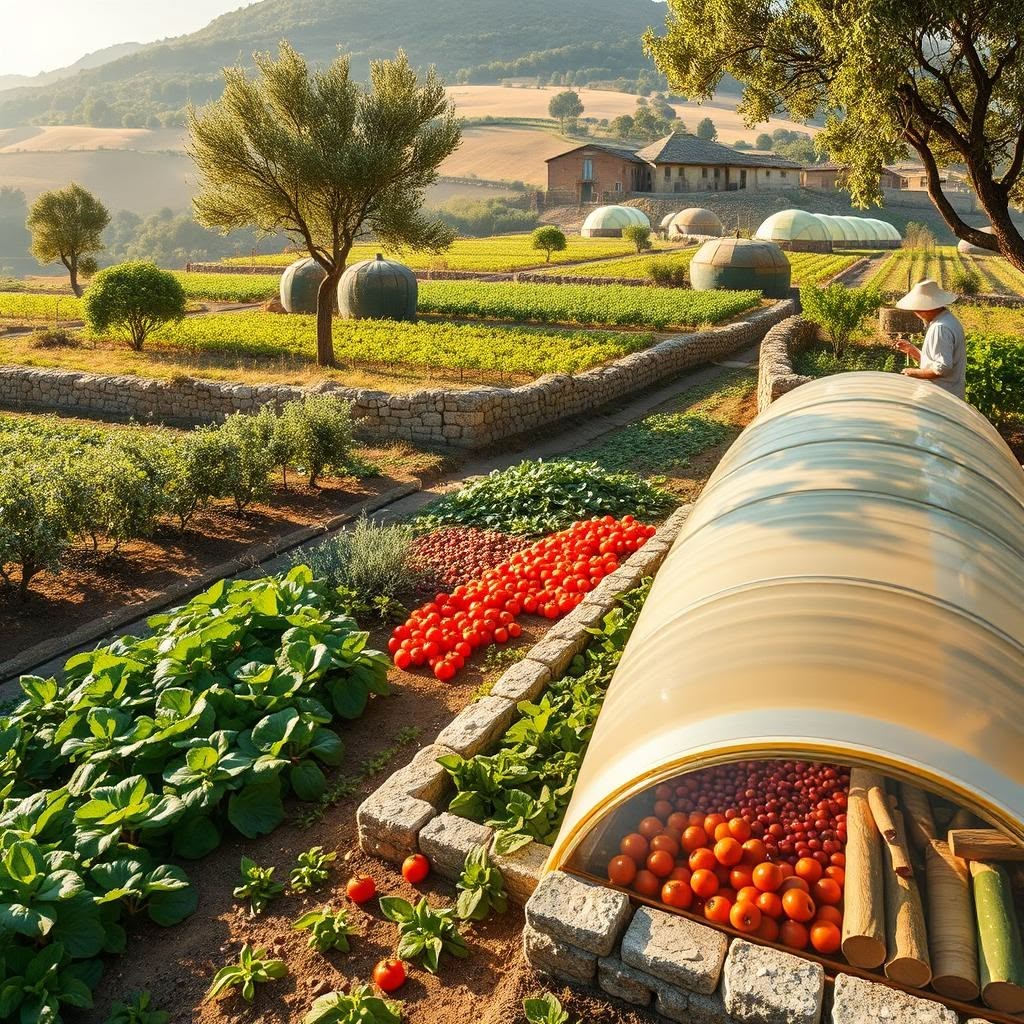
But Romans went beyond simply finding microclimates—they actively created them. Columella describes in detail the construction of growing spaces specifically designed to capture and retain heat. Stone walls built to absorb daytime solar radiation would release heat gradually overnight, protecting tender crops from frost. Windbreaks were strategically positioned to shelter plants while still allowing adequate sunlight.
Water was another microclimate management tool. Roman farmers understood that water bodies moderate temperature extremes. Garden ponds and water channels served multiple purposes: irrigation, fish production, and creating thermal buffers that protected nearby plants from temperature fluctuations.
Perhaps most ingenious were the Roman cold frames and cloches. Using frames covered with translucent materials (thin sheets of selenite—a crystalline form of gypsum—or oiled cloth), they created protected growing environments that functioned similarly to modern cold frames. These structures allowed for early seeding and late-season harvest extension without external heat sources.

The Roman Water Management Revolution
While aqueducts stand as Rome’s most visible water engineering achievements, their agricultural water management systems were equally impressive and perhaps more relevant to today’s challenges.
Roman farmers developed sophisticated rainwater harvesting systems that captured precipitation during wet periods for use during dry times. Beyond simple collection, they created multi-stage filtration systems that improved water quality while reducing evaporation loss. These systems ranged from elaborate stone-lined cisterns on large estates to simple but effective water collection designs for small farm plots.
Irrigation wasn’t applied indiscriminately but precisely calculated based on crop needs and soil conditions. Columella provides detailed guidance on water requirements for different plants and warning signs of both under and over-irrigation. This water-conscious approach stands in stark contrast to many modern irrigation practices that often waste significant amounts through imprecise application.
Most innovative was the Roman understanding of what we now call “passive water harvesting”—landscape modifications that slow, spread, and sink water naturally. Contour berms, swales, and check dams redirected water flow across landscapes, ensuring maximum soil absorption and minimal runoff. These techniques simultaneously prevented erosion, recharged groundwater, and reduced irrigation needs.
Roman farmers also mastered the art of drainage. Understanding that waterlogged soil damages most crops, they developed elaborate drainage systems using clay pipes and gravel-filled trenches to remove excess water while retaining moisture in the root zone. These drainage principles still inform modern designs but are often overlooked in conventional farming.
Soil Building: The Foundation of Roman Agricultural Success
Modern sustainable farmers often speak of “building” soil rather than simply maintaining it. This concept wasn’t new to the Romans—it was central to their agricultural philosophy.
Roman farmers understood soil as a living system that required regular nourishment. Cato’s writings include detailed formulas for various compost mixtures tailored to specific crops and soil conditions. These weren’t simple piles of agricultural waste but carefully constructed blends of plant material, animal manures, wood ash, and other ingredients, proportioned precisely and aged properly before application.
Beyond compost, Romans practiced what we now call “sheet mulching”—covering soil with layers of organic materials that gradually decomposed. This protected soil from erosion and temperature extremes while slowly releasing nutrients. The practice maintained soil moisture during dry periods and prevented weed growth without chemical interventions.
Romans also understood the concept of nutrient cycling between livestock and cropland. Animal manures weren’t waste products but valuable resources allocated strategically throughout the farm. Different animal manures were matched to specific crops based on their nutritional composition—knowledge that predated chemical soil analysis by centuries.
Perhaps most forward-thinking was the Roman practice of growing specific plants solely to nourish soil. Before the science of soil biology was understood, they observed that certain plants seemed to “refresh” soil when incorporated. This intuitive understanding of green manures and cover crops demonstrates an ecological awareness that modern agriculture is only now rediscovering.
Implementing Roman Wisdom in Modern Contexts
The power of these ancient techniques lies not in historical curiosity but in their practical application today. Modern farmers who have studied and implemented Roman methods report remarkable results, even in challenging climates.
For today’s market gardeners and small-scale farmers, the Roman succession planting approach offers a practical pathway to extend productive seasons without significant infrastructure investment. By adapting Columella’s planting calendar to local conditions, farmers can keep harvests flowing through traditionally “dead” periods, maintaining customer relationships and income streams year-round.
For larger operations, Roman-inspired rotation systems provide a template for reducing external inputs while maintaining productivity. By incorporating soil-building phases into rotation plans, farms can gradually reduce dependency on synthetic fertilizers while improving overall soil health and resilience against extreme weather events.
Home gardeners perhaps stand to gain the most from Roman techniques. The intensive, space-efficient methods described in Roman texts were designed for relatively small plots—making them perfectly suited for today’s backyard gardens. By applying principles of succession planting, microclimate manipulation, and intensive soil building, home gardeners can dramatically increase production from limited space.
What makes these techniques particularly valuable today is their low-tech, low-energy nature. In an era of rising input costs and climate uncertainty, methods that rely on ecological knowledge rather than purchased products or fossil fuels offer both economic and environmental advantages.
The Bridge Between Ancient Wisdom and Future Food Security
As we face unprecedented agricultural challenges, the Roman approach offers something uniquely valuable: proven resilience. These weren’t experimental techniques but methods refined over centuries and tested across one of history’s largest empires, spanning diverse climates and conditions.
The Romans understood something fundamental that industrial agriculture often overlooks: farms are not factories but living systems. Their approach wasn’t to dominate natural processes but to align with them, enhancing natural productivity through careful observation and thoughtful intervention.
This philosophy aligns perfectly with today’s regenerative agriculture movement. What modern sustainable farmers are discovering through science, Romans understood through generations of careful observation. The convergence of these ancient insights with modern ecological understanding creates powerful possibilities for reimagining our food systems.
Perhaps most importantly, Roman agricultural wisdom offers hope in uncertain times. While climate change presents unprecedented challenges, these ancient techniques demonstrate that productive, resilient agriculture is possible without massive energy inputs or environmental degradation. The solutions we need might not require new technology but recovered knowledge.
Joining the Agricultural Renaissance
The rediscovery of Roman agricultural wisdom represents more than historical curiosity—it offers practical solutions to immediate challenges. By combining these time-tested techniques with modern ecological understanding, we can create farming systems that are productive, resilient, and regenerative.
If you’re intrigued by the possibilities of implementing these ancient-yet-innovative approaches in your own growing context, JP Farmer’s upcoming free webinar “Ancient Wisdom, Modern Harvests” will provide practical guidance on adapting Roman techniques to contemporary farms and gardens. This session will translate historical knowledge into actionable steps for extending your productive season regardless of your climate or scale.
The Romans understood that agricultural knowledge was too valuable to keep private. Their greatest farming minds documented their methods specifically to share wisdom across generations. In that same spirit, we invite you to join a community of growers rediscovering these powerful techniques and adapting them to today’s challenges.
The secret to year-round harvests hasn’t been lost—it’s been waiting in ancient texts, ready to revolutionize modern agriculture once again. The question isn’t whether these methods work—history has already proven they do. The question is whether we’re ready to learn from our agricultural ancestors and apply their wisdom to create more resilient food systems for our uncertain future.


