
The Hidden Cost of Modern Irrigation Most Farmers Never Calculate
The sun beats down on cracked soil as a farmer watches his water meter spin—along with his monthly bill. Across America’s farmlands, a silent crisis unfolds as growers pour thousands of gallons into inefficient irrigation systems, only to see diminishing returns and depleted aquifers. Water, once considered abundant, has become liquid gold.
For generations, we’ve accepted water waste as the unavoidable cost of growing food. Sprinkler systems spray precious resources into the air where much evaporates before reaching plant roots. Flood irrigation drowns one section of land while leaving others parched. And the financial burden? It’s crushing small-scale farmers who watch helplessly as input costs rise while crop prices remain stagnant.
The true cost goes beyond monthly utility bills. There’s the environmental impact of depleting groundwater faster than nature can replenish it. There’s the stress of wondering if water restrictions will force difficult decisions about which crops survive and which wither. And perhaps most painfully, there’s the knowledge that somewhere in our agricultural heritage, we lost wisdom that sustained civilizations for millennia.
But what if there was another way? What if the solution to modern farming’s water crisis wasn’t found in high-tech gadgetry but in the ingenious systems developed by civilizations that thrived in arid environments thousands of years ago?
The Ancient Solution Hidden in Plain Sight
While today’s farmers struggle with water management, the ancient Romans created irrigation systems so effective that some still function after two millennia. These master engineers understood a fundamental principle modern agriculture has forgotten: water should travel with purpose, not waste.
Roman aqueducts and irrigation channels delivered water precisely where needed through carefully calculated gradients. They harnessed gravity instead of electricity, used natural filtration instead of chemicals, and created resilient systems that required minimal maintenance. Most importantly, they viewed water as sacred—a resource to be guided thoughtfully rather than pumped indiscriminately.
When these principles are adapted to modern small-scale farming, something remarkable happens. Water consumption drops by 60-70% while crop yields increase dramatically. Plants receive moisture directly at their root zones, exactly when they need it. Soil health improves as consistent moisture creates ideal conditions for beneficial microorganisms. And farmers regain the connection to their land that comes from working with natural systems rather than fighting against them.

The Transformation: From Water-Waster to Resource-Steward
Imagine walking your fields knowing that every drop of water serves a purpose. Instead of watching puddles form in low spots while high areas remain dry, you’ve created a system where gravity delivers moisture uniformly across your growing area. Your irrigation doesn’t depend on electricity or fossil fuels—it works silently, efficiently, day and night.
This isn’t fantasy. By combining ancient wisdom with modern materials, you can transform your relationship with water. The system we’re about to explore has helped farmers reduce irrigation frequency from daily to weekly while producing healthier, more abundant crops.
The handcrafted irrigation system inspired by Roman aqueducts creates a before-and-after contrast that’s immediately visible. Before: stress about water costs, inconsistent crop growth, and constant maintenance. After: predictable water usage, uniform plant development, and a system that largely maintains itself.
Let’s explore how to bring this transformation to your farm or garden.
Building Your Handcrafted Irrigation System: The Foundation
The beauty of this system lies in its adaptability. Whether you’re working with a quarter-acre market garden or several acres of specialty crops, the principles remain the same. You’ll need to customize dimensions based on your specific situation, but the core elements don’t change.
Understanding Your Land’s Natural Flow
Romans never fought against the natural contours of the land—they worked with them. Your first step is to observe how water naturally moves across your property. During a heavy rain, where does water collect? Where does it drain quickly? These observations reveal the natural path water wants to take.
For maximum efficiency, your irrigation system should complement these natural patterns. Take time to map your land’s subtle elevation changes using simple tools like a water level (a clear tube filled with water) or more modern options like laser levels. Even a few inches of elevation difference can be harnessed for water movement.
The ideal location for your main reservoir is at the highest practical point of your growing area. From there, gravity will do the work of distributing water through your system. If your land is perfectly flat, don’t worry—we’ll address alternatives shortly.
Materials: Bridging Ancient and Modern
The Romans built with stone and fired clay. While beautiful, these materials aren’t practical for most modern farmers. Fortunately, we can maintain the principles while using more accessible materials:
For your main channels (the equivalent of Roman aqueducts), consider:
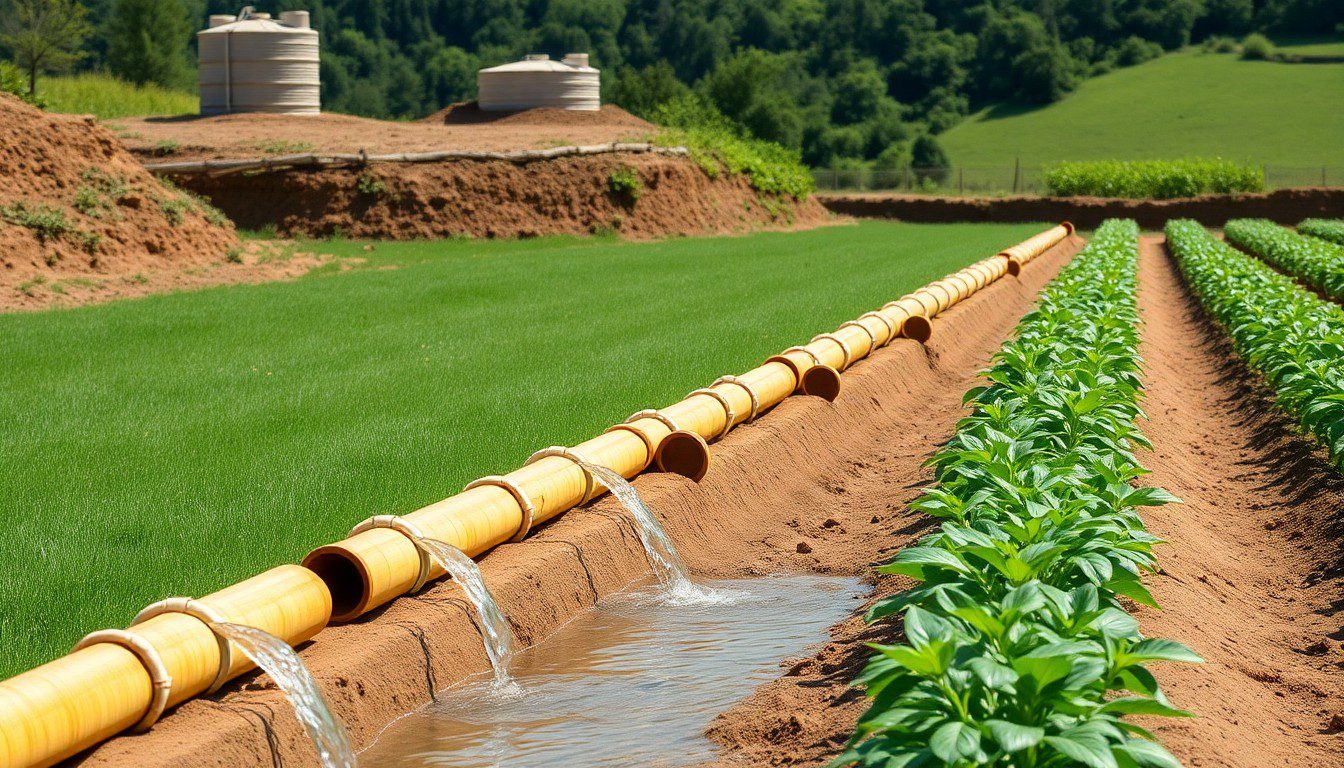
– Bamboo halves (sustainable and naturally water-resistant)
– Food-grade PVC pipe (practical though less aesthetic)
– Terracotta half-pipes (closest to traditional materials but more expensive)
– Repurposed gutters (economical for smaller systems)
For the distribution network (smaller channels reaching individual plants):
– Clay ollas (unglazed clay pots buried near plant roots)
– Porous hose made from recycled materials
– Micro-channels lined with pebbles
– Buried perforated pipe for deep root watering
For the reservoir system:
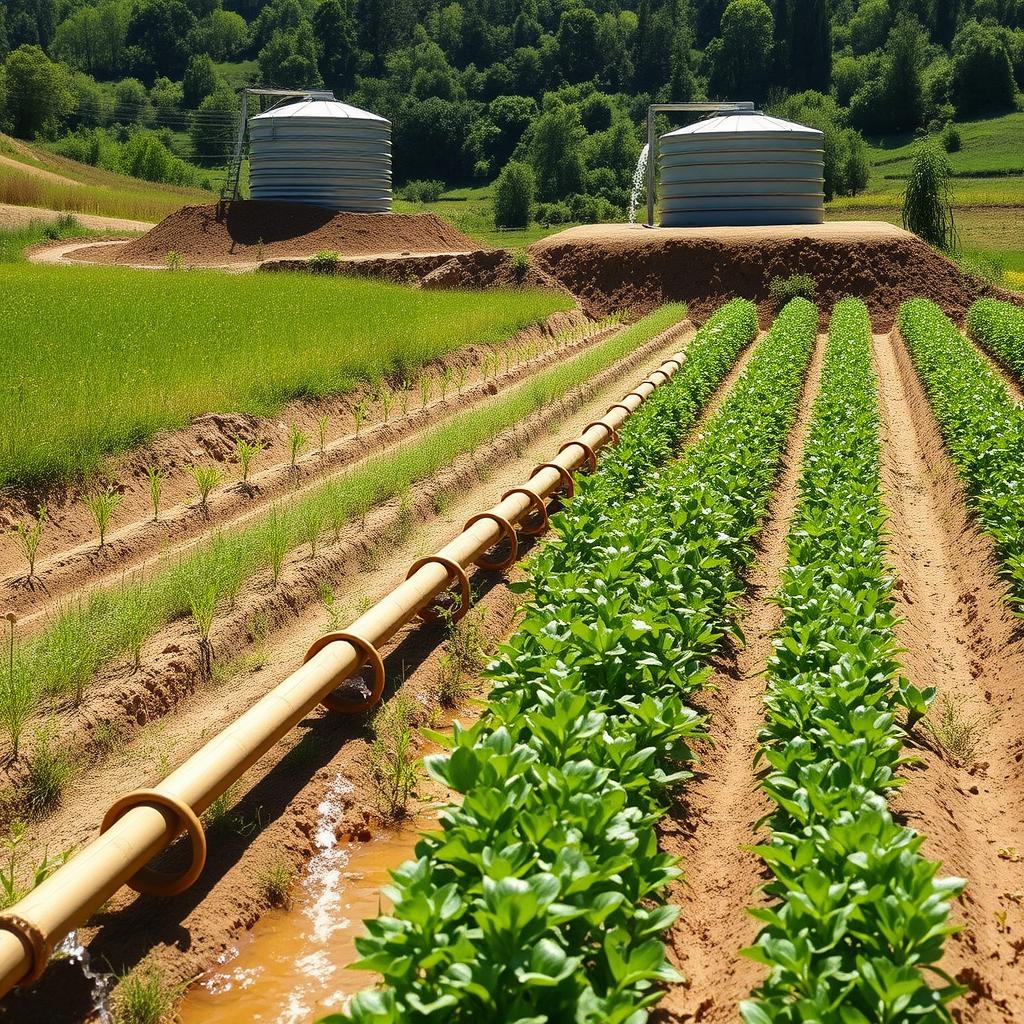
– Rainwater collection tanks
– Lined ponds with natural filtration
– Repurposed IBC totes
– Traditional cisterns if available
The key is creating a system where water moves almost entirely via gravity, minimizing or eliminating pumps and power requirements. Remember that authenticity comes from honoring principles, not necessarily using identical materials to those available two thousand years ago.

Constructing Your System: Step by Step
Step 1: Establish Your Water Source and Main Reservoir
Your system begins with water collection. Romans diverted streams and springs, but you’ll likely be capturing rainwater or using existing well or municipal sources. The critical element is creating sufficient storage to smooth out periods between rainfall.
Your main reservoir should be positioned to create maximum pressure through gravity. Each foot of elevation provides 0.433 PSI of water pressure—not much, but enough when designed properly. Elevate tanks using earthen berms if natural elevation isn’t available.
Incorporate a simple filtration system using graded gravel, sand, and charcoal to prevent debris from clogging your distribution channels. This mimics the Roman sedimentation tanks that kept their aqueducts flowing for centuries.
Step 2: Create Your Primary Distribution Channel
From your reservoir, establish a main channel that follows the contour of your land. This is your “aqueduct”—the primary water highway that will feed all secondary channels. The gradient is crucial: too steep and water rushes too quickly, causing erosion; too shallow and water moves too slowly or stagnates.
Romans typically used a gradient of 1:200 (a drop of one unit for every 200 units of distance). For modern small-scale systems, aim for 1-2 inches of drop for every 10 feet of channel. Use a level to establish this consistent gradient as you construct your channel.
Your main channel should be covered to prevent evaporation and contamination—another lesson from Roman design. Simple wooden lids, hinged for easy access and maintenance, work well here.
Step 3: Develop Secondary Distribution Pathways
From your main channel, create smaller pathways that direct water to specific growing areas. These secondary channels can be created using smaller diameter pipes or narrow trenches lined with clay or modern liner material.
Include control points—simple gates or valves—that allow you to direct water to different zones of your garden or farm. This zoned approach lets you customize watering for different crop needs and growth stages.
For sloped areas, incorporate terracing principles used by ancient farmers worldwide. Each level should have its own channel running along the contour, creating even distribution across the growing area.
Step 4: Implement Final Delivery Systems
The genius of Roman irrigation wasn’t just in moving water over distances but in delivering it precisely where needed. For your system, this means creating the final connection between distribution channels and plant roots.
Clay ollas (unglazed pottery vessels) buried near plants provide slow, consistent moisture as water seeps through the clay. Modern equivalents include porous irrigation hose or buried perforated pipe.
For row crops, create narrow furrows that fill when gates are opened, allowing water to infiltrate directly at the root zone. Edge these furrows with mulch to prevent evaporation—something the Romans understood well before modern science confirmed its benefits.
Step 5: Add Control and Monitoring Elements
While the Romans used human operators to control water flow, you can incorporate simple automatic elements. Float valves can maintain water levels in distribution points. Overflow channels can direct excess water back to secondary storage or to crops with higher water needs.
Create simple measuring points where you can visually check water flow rates. Traditional methods used notched sticks; you might use marked transparent sections of pipe or basic flow meters.
Maintenance: The Key to Longevity
The Roman aqueducts that still stand weren’t just well-built—they were consistently maintained. Your system requires similar attention, though far less than conventional irrigation.
Establish a seasonal maintenance schedule that includes:
1. Pre-growing season inspection of all channels, clearing any debris and checking for damage from winter freezing.
2. Mid-season cleaning of filters and reservoirs to prevent algae buildup.
3. Post-harvest system drainage in cold climates to prevent freeze damage.
4. Annual reinforcement of earthworks and repair of any damaged sections.
The beauty of gravity-fed systems is their resilience—with proper maintenance, many components will last decades rather than seasons. This represents a dramatic shift from the constant replacement cycle of conventional irrigation equipment.

Adapting Ancient Wisdom to Different Growing Environments
The principles of Roman water management apply across diverse growing environments, though the implementation varies. Here’s how to adapt these concepts to specific conditions:
For Flat Terrain
Without natural elevation differences, create artificial height for your reservoir using berms or elevated platforms. Even modest height differences of 2-3 feet can generate sufficient pressure for small systems. Alternatively, consider wind-powered pumps that lift water to elevated tanks, from which gravity takes over.
For Arid Regions
In dry climates, incorporate deeper channels and more extensive reservoir capacity. Add more complete covering to prevent evaporation, and consider underground components that maintain cooler water temperatures. Include overflow systems that direct any rainfall directly into your storage system.
For High-Rainfall Areas
In regions with abundant precipitation, focus on rainwater harvesting and proper drainage elements. Create bypass channels that prevent system overflow during heavy rains, and incorporate settling basins that improve water quality before distribution.
The Results: Beyond Water Savings
Farmers who have implemented these traditional-inspired systems report benefits far beyond reduced water bills. When plants receive consistent moisture directly at their root zones—without the stress of fluctuating between drought and flood conditions—they develop stronger immune systems and more extensive root networks.
The result is not just water efficiency but notably improved yields. Plants direct energy toward fruit production rather than survival mechanisms. Consistent moisture creates ideal conditions for beneficial soil microorganisms that enhance nutrient availability. And many growers report improved flavor profiles in fruits and vegetables—a direct result of steady, appropriate hydration.
Perhaps most significantly, these systems reconnect farmers with natural cycles. Instead of fighting against environmental limitations, you’re working within them—a fundamental shift that reduces stress while improving outcomes.
The Investment: Understanding True Costs and Returns
Building a handcrafted irrigation system requires initial investment of both time and resources. Depending on your scale and material choices, costs typically range from $500 for a small garden system to several thousand dollars for larger acreage.
However, this investment typically pays for itself within 1-2 growing seasons through:
– Reduced water costs (often 60-70% lower than conventional systems)
– Improved crop yields and quality (typically 30-100% increases)
– Decreased labor for watering and monitoring
– Reduced need for fertilizers as nutrients stay in the root zone rather than leaching away
– Minimal ongoing replacement costs compared to conventional irrigation
When calculating return on investment, consider not just direct financial returns but also improved sustainability and resilience. A farm that requires significantly less water is better positioned to thrive during drought conditions or water restrictions.
Becoming a Water Steward: The Bigger Picture
Implementing this system places you within a lineage of agricultural wisdom that spans millennia. You’re not just saving water; you’re participating in the revitalization of traditional knowledge that sustained civilizations through challenging climatic conditions.
As water becomes increasingly precious globally, your farm or garden becomes a demonstration of possibility—showing that production and conservation can work hand in hand. Many farmers who adopt these methods find themselves becoming educators, showing others how ancient wisdom can address very modern challenges.
This is farming that honors the past while securing the future—creating agricultural systems that can sustain families and communities regardless of changing climate conditions or resource availability.
Your Next Steps: From Concept to Reality
Ready to transform your relationship with water and dramatically improve your growing results? Here’s how to move forward:
First, thoroughly map your growing area, noting elevation changes, current water sources, and growing zones. This baseline assessment will inform your entire design process.
Next, start small—convert one section of your growing area to this system and observe the results before expanding. This allows you to refine your approach based on your specific conditions.
Document your water usage before and after implementation. These concrete measurements will help you quantify your savings and improvements, providing valuable data for future decisions.
Finally, connect with others implementing similar systems. While the principles remain consistent, regional adaptations and innovations continue to emerge as more growers incorporate traditional wisdom into modern practice.
Ready to Transform Your Farm with Ancient Wisdom?
We’ve created a comprehensive blueprint that takes you step-by-step through designing and building your own Roman-inspired irrigation system. This detailed guide includes precise measurements, material lists for different scales, and troubleshooting advice for common challenges.
Download our “Ancient Wisdom, Modern Yields” blueprint today and join the growing community of farmers rediscovering sustainable water management. Or register for our upcoming hands-on workshop where you’ll help construct a working system while learning alongside experienced builders.
Water shouldn’t be your farm’s greatest expense—it should be its greatest ally. By looking to the past, you’ll create a more abundant and resilient future for your land and those who depend on it.


