There’s a secret that the wine industry doesn’t want you to know. Every time you uncork that familiar bottle from the supermarket shelf, you’re participating in a massive deception that has quietly transformed one of humanity’s oldest crafts into something unrecognizable from its origins.
The comfortable lie we tell ourselves is that wine is wine. That the liquid in a five-dollar bottle shares the same essential DNA as what ancient Romans poured into their ceremonial chalices. But the uncomfortable truth cuts much deeper than most wine drinkers realize, and understanding it will forever change how you perceive that glass in your hand.
The Great Divide: When Craft Became Industry
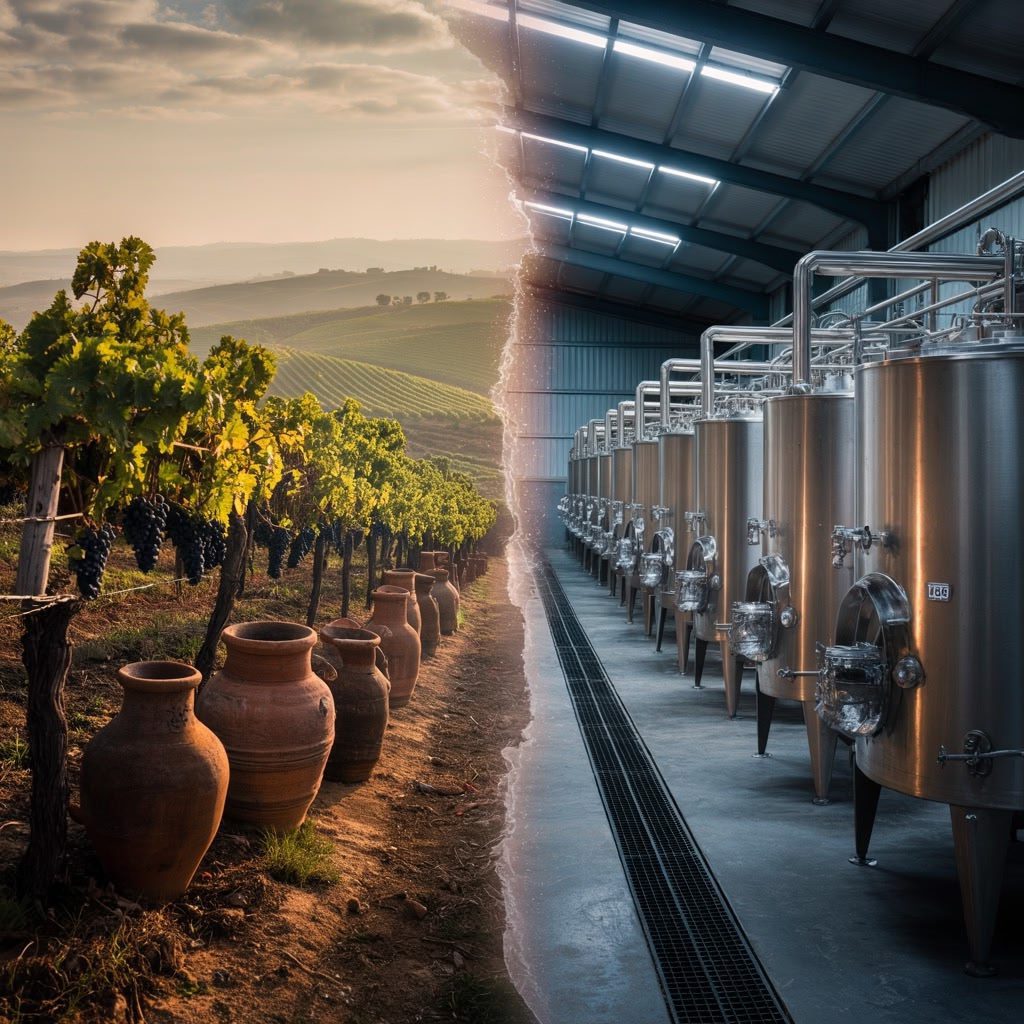
Picture yourself standing in a vineyard thousands of years ago, watching as weathered hands carefully select each grape cluster, feeling the weight and ripeness with fingertips that have learned to read the language of the vine. The process unfolds slowly, reverently, with an understanding that great wine cannot be rushed or manufactured—it must be coaxed into existence through patience, skill, and an almost mystical connection between human intention and natural forces.
Now fast-forward to today’s industrial wine facilities, where massive steel tanks process thousands of gallons simultaneously, where chemical additives ensure consistency, and where the ancient dance between winemaker and grape has been replaced by computerized systems designed for efficiency and profit margins. This isn’t evolution—it’s a fundamental transformation of purpose.
The philosophical chasm between these approaches runs deeper than mere methodology. Ancient winemaking methods operated on the principle that wine was a living expression of its environment, a liquid manifestation of soil, climate, and human care combined in harmonious balance. Modern mass production, however, treats wine as a commodity to be manufactured, standardized, and optimized for market demands rather than authentic quality.

What You Taste When Authenticity Disappears
The sensory differences between mass-produced and traditionally crafted wines aren’t subtle—they’re profound, though many drinkers have never experienced anything beyond industrial production to recognize what they’re missing. When you sip a wine created through ancient methods, you’re tasting the full spectrum of what fermentation was meant to be.
Traditional winemaking preserves the complete flavor profile that develops naturally when grapes are allowed to express their terroir without chemical interference. The complex interplay of wild yeasts, extended fermentation periods, and minimal intervention creates layers of taste that unfold gradually on your palate, telling the story of the specific vineyard, season, and maker’s philosophy.
Mass-produced wines, by contrast, undergo processes designed to eliminate variables rather than celebrate them. Commercial yeast strains replace the diverse ecosystem of wild yeasts that would naturally inhabit the grape skins. Sulfites are added in quantities that would shock ancient winemakers, not for preservation alone, but to control fermentation so tightly that the wine’s personality becomes standardized rather than unique.
The result is wine that tastes uniform, predictable, and oddly hollow—like listening to a symphony where most of the instruments have been muted to ensure nothing disrupts the main melody. You might not consciously recognize what’s missing, but your senses register the absence of depth, the lack of that indefinable quality that makes truly exceptional wine memorable long after the last sip.
The Hidden Compromises of Modern Production
Understanding what happens in modern wine facilities reveals why the end product feels fundamentally different from traditional wine, even when produced from similar grape varieties. The pressure to create consistent products at scale has led to shortcuts that would have been unthinkable to ancient winemakers who viewed their craft as both art and sacred responsibility.
Temperature-controlled fermentation, while technologically impressive, eliminates the natural variations that create complexity in traditional wines. Ancient methods allowed fermentation to proceed at the pace and temperature that the wine itself demanded, resulting in unique characteristics that could never be replicated exactly—each vintage became its own unrepeatable expression.
The use of commercial enzyme preparations speeds up processes that traditional methods allowed to unfold naturally over months or even years. Where ancient winemakers understood that great wine requires time for tannins to soften, flavors to integrate, and the wine to develop its full character, modern production prioritizes quick turnaround to meet market demands and financial pressures.
Perhaps most significantly, mass production treats wine as a problem to be solved rather than a mystery to be explored. Every variable is controlled, every outcome predicted, every bottle designed to taste exactly like every other bottle. The ancient understanding that wine should reflect its specific origins, vintage conditions, and the unique choices of its maker has been sacrificed for the reliability that modern consumers expect.

Why Ancient Roman Wisdom Still Matters
The Romans didn’t just make wine—they elevated it to an art form that combined practical knowledge with deep cultural significance. Their approaches, developed over centuries of refinement, weren’t merely traditional for tradition’s sake. They represented accumulated wisdom about how to coax the very best from grapes while respecting the natural processes that create truly exceptional wine.
Roman winemakers understood fermentation as a collaboration with nature rather than a process to be dominated. They used techniques like extended skin contact and natural settling that modern science now recognizes as superior for developing complex flavors and stable wines, though these methods require far more time and skill than their contemporary shortcuts.
The Roman philosophy viewed winemaking as inseparable from the land itself. Their concept of terroir—though they didn’t use that French term—recognized that exceptional wine could only come from the marriage of specific soils, climates, grape varieties, and human expertise passed down through generations. This holistic understanding created wines that were expressions of place and culture rather than manufactured products.
When modern winemakers choose to follow these ancient principles, they’re not being nostalgic or impractical. They’re recognizing that some discoveries about quality and authenticity transcend technological advancement. The Roman methods survived for centuries because they produced results that satisfied both the palate and the soul—something that mass production, for all its efficiency, struggles to achieve.
The Cultural Cost of Choosing Convenience
Every time we choose mass-produced wine over traditionally crafted alternatives, we participate in the gradual erosion of cultural knowledge that took millennia to develop. The skills, techniques, and deep understanding required for ancient winemaking methods aren’t just quaint historical curiosities—they represent humanity’s relationship with one of our oldest and most meaningful crafts.
Consider what happens when traditional knowledge disappears. The artisan who understands how to read grape skins for optimal harvest timing, who can manage fermentation by taste and smell rather than digital readouts, who knows how different barrel woods will influence flavor development over years of aging—this person carries irreplaceable wisdom that cannot be googled or downloaded.
Mass production doesn’t just change the wine; it changes us as consumers. When everything tastes similar, when every bottle delivers predictable results, we lose our ability to appreciate the subtle distinctions that make wine fascinating. Our palates become accustomed to the simplified flavor profiles of industrial production, making it harder to recognize and value the complexity that authentic methods create.
The cultural significance extends beyond individual taste preferences. Wine has historically served as a bridge between communities, a reflection of regional identity, and a connection to ancestral traditions. When we allow mass production to dominate the market, we sacrifice the diversity that makes wine a meaningful expression of human creativity and natural beauty.

Recognizing Authentic Craftsmanship in a Manufactured World
Learning to identify wines created through traditional methods requires developing sensitivity to qualities that mass production eliminates. Authentic wines possess characteristics that reveal their origins and methods, though recognizing these markers takes practice and attention that our fast-paced culture often discourages.
Traditional wines often exhibit what some describe as “wildness”—subtle inconsistencies and unexpected flavor notes that reflect the natural variations in their creation process. Rather than flaws, these characteristics represent authenticity, the wine’s unique fingerprint that could never be exactly duplicated.
The mouthfeel of traditionally crafted wine differs markedly from mass-produced alternatives. Ancient methods create wines with better integration between alcohol, acidity, and tannins, resulting in a smoother, more satisfying drinking experience that doesn’t rely on added sugar or artificial manipulation to achieve balance.
Perhaps most tellingly, wines created through traditional methods tend to improve with time in ways that mass-produced wines cannot. The complex chemical interactions that develop during natural fermentation and aging create wines that evolve gracefully, revealing new characteristics years after production. This aging potential reflects the fundamental difference between wine as a living product versus wine as a manufactured commodity.
Making the Choice for Authenticity
Understanding the difference between mass-produced and traditionally crafted wine creates a moment of decision. You can continue accepting the convenient fiction that all wine is essentially the same, or you can begin seeking out producers who maintain ancient standards in our modern world.
This choice involves more than just personal preference—it’s about supporting artisans who refuse to compromise their craft for efficiency, who maintain traditional knowledge that might otherwise disappear, and who believe that some things are worth doing slowly and carefully despite market pressures.
Finding authentic wines requires looking beyond marketing claims to understand actual production methods. Seek out producers who emphasize minimal intervention, who use native yeasts, who allow extended fermentation periods, and who view their role as facilitators rather than controllers of the winemaking process.
The investment in authentic wine pays dividends beyond the immediate drinking experience. Each bottle becomes a connection to centuries of accumulated wisdom, a support for artisans maintaining cultural traditions, and an education in what wine was meant to be before industrialization simplified it beyond recognition.
The Path Forward: Reclaiming Wine’s True Heritage
The uncomfortable truth about mass-produced wine versus ancient methods isn’t meant to shame or discourage. Instead, it’s an invitation to discover what you’ve been missing and to become part of preserving something beautiful and meaningful in our increasingly homogenized world.
Every choice to seek out traditionally crafted wine sends a message to producers that authenticity still matters, that consumers are willing to pay for real quality, and that ancient wisdom deserves preservation alongside technological advancement. This individual action, multiplied across many conscious consumers, has the power to influence an entire industry.
The journey toward appreciating authentic wine transforms not just your drinking experience but your entire relationship with craftsmanship, tradition, and quality. You begin to recognize excellence in other areas of life, to value the time and skill required for genuine artistry, and to understand why some shortcuts ultimately cost more than they save.
As you stand at the wine shelf making your next selection, remember that you’re choosing between two fundamentally different philosophies. One prioritizes convenience, predictability, and profit. The other honors tradition, celebrates uniqueness, and maintains ancient wisdom for future generations. The uncomfortable truth is that these choices shape not just your glass tonight, but the world we leave behind.
Consider this your invitation to experience wine as it was meant to be experienced—as a living expression of place, time, and human artistry that connects you to thousands of years of cultural heritage. The difference isn’t just in the bottle; it’s in the story, the tradition, and the authentic craftsmanship that makes each sip a celebration of humanity’s oldest and most refined pleasures.


