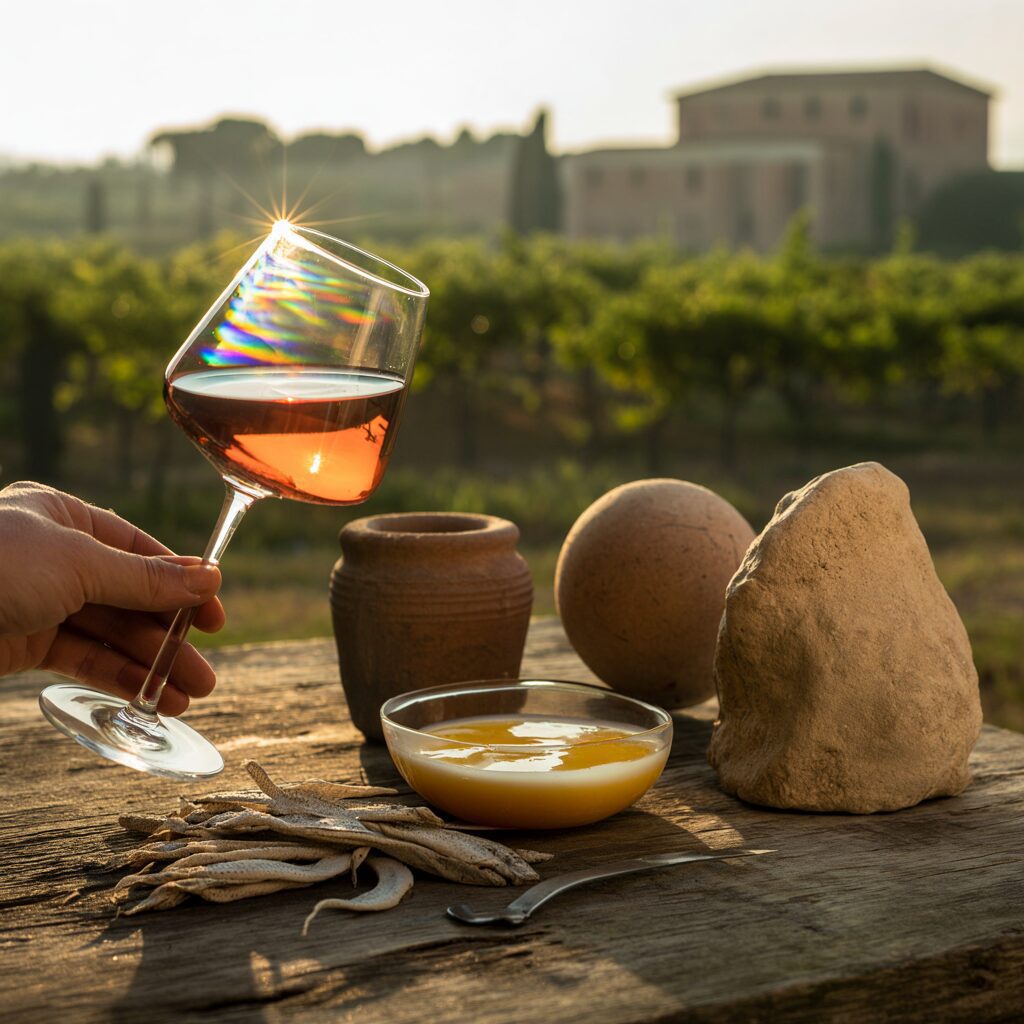
The golden liquid catches the light, transforming an ordinary glass of wine into a prism of amber brilliance. Yet this seemingly simple pleasure – a perfectly clear wine – represents one of winemaking’s most enduring challenges. For centuries, winemakers have battled against the stubborn haze of proteins, tannins, and particulate matter that can transform an elegant vintage into a cloudy disappointment.
What if the solution to this modern dilemma has been hiding in plain sight for over two millennia? What if ancient Romans – those masters of innovation and practical luxury – had already discovered the secrets to achieving crystalline clarity in their prized Falernian and Caecuban wines?
The pursuit of wine clarity isn’t merely aesthetic vanity. Clarity speaks to a wine’s stability, its aging potential, and ultimately its market value. In an industry where perception deeply influences experience, the brilliant transparency of a well-fined wine signals care, craftsmanship, and quality. Yet today’s winemakers increasingly find themselves caught between modern industrial solutions and the growing consumer demand for natural, traditional approaches.
This tension between tradition and modernity, between chemical intervention and natural processes, reveals a fascinating historical circle. The ancient Romans – without modern technology or scientific understanding – developed sophisticated fining methods that modern research increasingly validates as both effective and remarkably aligned with contemporary natural winemaking philosophies.
The Clarity Crisis: Why Wine Gets Cloudy
Before we dive into ancient solutions, we must understand the fundamental challenge. Wine clarity represents one of winemaking’s most persistent technical problems. Unlike distilled spirits, wine contains a complex suspension of organic compounds – proteins, polyphenols, tannins, and various particulate matter – that naturally resist settling.
This natural turbidity isn’t harmful, but it conflicts with consumer expectations of brilliance and transparency. A hazy wine is often perceived as flawed or poorly made, regardless of its flavor profile or quality. Furthermore, these suspended particles can create genuine issues beyond aesthetics – they may contribute to premature oxidation, unstable flavor development, or unpredictable aging characteristics.
Modern commercial winemaking has developed numerous solutions – from bentonite clay and synthetic polymers to mechanical filtration systems. Yet each intervention comes with tradeoffs. Aggressive filtration can strip wines of character-building compounds. Chemical clarifiers may leave trace elements that sensitive palates can detect. The quest for perfect clarity often creates imperfect compromises.
The most fascinating aspect of this modern dilemma? The Romans faced exactly the same problems without modern technology – and their ingenious solutions may actually surpass our contemporary approaches in both effectiveness and purity.

Ancient Roman Winemaking: A Culture of Innovation
To understand Roman fining techniques, we must first appreciate the central role of wine in Roman civilization. Wine wasn’t merely a beverage – it represented a cornerstone of Roman identity, economy, and social hierarchy. The Romans transformed viticulture from a regional Mediterranean practice into a sophisticated industry spanning their entire empire, from North Africa to Britain.
Roman wine culture demanded clarity. Historical texts repeatedly praise the brilliance of properly aged and clarified wines. Pliny the Elder, that tireless chronicler of Roman daily life, specifically mentions the importance of wine clarification in his Natural History, describing wines that “shine with perfect brilliance” after proper treatment and aging.
The Romans approached winemaking with characteristic pragmatism and innovation. They understood fermentation not as a scientific process but as a predictable transformation they could influence through systematic intervention. Their approach to wine clarity followed this same practical philosophy – observe, experiment, and perfect techniques that delivered consistent results.
What makes their achievements remarkable is that they developed sophisticated fining solutions without understanding the molecular interactions involved. Through centuries of observation and refinement, Roman winemakers created a clarification toolkit that addressed specific wine problems with targeted natural materials.
The Roman Fining Arsenal: Natural Solutions for Perfect Clarity
The Romans developed an impressive array of fining agents, each addressing specific clarity issues. These natural approaches reveal a sophisticated understanding of wine behavior that predates modern chemistry by millennia.
Perhaps most famous was their use of albumin – primarily from egg whites. Roman texts describe the practice of adding beaten egg whites to wines, particularly red varieties with heavy tannin structures. The protein in egg whites creates a molecular mesh that binds with suspended tannins and larger particulates, forming heavier compounds that settle to the bottom of storage vessels.
Modern analysis confirms this technique’s effectiveness. Egg white proteins have a particular affinity for tannin molecules, creating bonds that accelerate the clarification process without stripping the wine of essential flavor compounds. This selective binding makes egg whites particularly valuable for clarifying red wines while preserving their structural integrity and aging potential.
Clay-based fining agents represented another cornerstone of Roman clarification. Historical texts mention various forms of “creta” or clay used to treat wines, particularly whites that showed protein haze. These natural clays – likely similar to modern bentonite – carried a negative electrical charge that attracted positively charged protein molecules, effectively removing them from suspension.
Perhaps most interesting was the Roman use of fish bladders and other collagen-rich materials. Pliny specifically mentions “ichthyocolla” – literally “fish glue” – derived from sturgeon bladders. This material, essentially identical to modern isinglass, contains collagen proteins that form a web-like structure in wine, gently capturing suspended particles without affecting flavor compounds.
These techniques weren’t used in isolation but as part of a systematic approach to clarification. Roman winemakers would select specific agents based on the wine’s characteristics, the specific clarity issue, and the desired outcome. This targeted methodology reveals a nuanced understanding of wine behavior that resonates with modern winemaking philosophy.

The Science Behind Ancient Wisdom
The brilliance of Roman fining techniques becomes even more apparent when examined through the lens of modern wine chemistry. Without understanding molecular structures or electrical charges, Roman winemakers developed solutions that precisely targeted the core causes of wine haziness.
Take protein stability – a persistent challenge in white wines. Proteins naturally present in wine can denature and form visible haze, particularly when exposed to heat. The Roman use of clay fining agents addressed this exact issue through what we now understand as ionic attraction – negatively charged clay particles binding with positively charged proteins.
Similarly, their approach to tannin management in red wines through egg whites demonstrates an intuitive understanding of protein-polyphenol interactions. The albumin proteins in egg whites selectively bind with larger, more astringent tannin molecules while leaving smaller, flavor-enhancing compounds in solution – precisely what modern winemakers attempt to achieve through careful fining protocols.
What’s particularly impressive is how Roman winemakers refined these techniques through careful observation rather than scientific instrumentation. They couldn’t measure protein concentration or polyphenol levels, yet they developed protocols that effectively managed these compounds through systematic trial and error over generations.
This historical refinement process highlights an often-overlooked aspect of traditional winemaking – its foundation in empirical observation across centuries. While modern enology might explain why these techniques work, the techniques themselves emerged from practical wisdom accumulated through generations of winemaking experience.
Ancient Techniques in Modern Cellars: The Revival
The contemporary wine world is experiencing a fascinating return to these ancient techniques, driven by both practical and philosophical considerations. As consumer preferences shift toward minimal intervention wines, winemakers are rediscovering the elegance and effectiveness of traditional fining approaches.
This revival isn’t merely nostalgia but represents a practical response to modern challenges. Natural fining agents offer significant advantages over synthetic alternatives – they tend to be more selective in what they remove, they break down naturally without leaving residues, and they align with organic and biodynamic certification requirements.
Imagine walking into a contemporary high-end winery and finding winemakers separating egg whites, precisely as their Roman predecessors did. This scene is increasingly common as producers seek effective clarification methods that preserve wine integrity and meet growing consumer demand for traditional processes.
The resurgence extends beyond egg whites to the full Roman clarification toolkit. Modern winemakers are experimenting with various clay formulations, exploring collagen-based fining agents like isinglass, and even investigating some of the more obscure Roman techniques mentioned in historical texts.
This revival represents more than technical pragmatism – it reflects a deeper philosophical shift in how winemakers view their craft. The Roman approach to wine clarification was fundamentally holistic, seeing fining not as a standalone intervention but as part of an integrated process that begins in the vineyard and continues through fermentation, aging, and eventual consumption.

Side-by-Side: Ancient vs. Modern Approaches
When directly comparing Roman fining techniques with modern industrial approaches, the contrasts – and surprising similarities – become apparent. Consider protein stabilization in white wines. The contemporary commercial approach typically involves bentonite clay, often processed and standardized, applied according to laboratory-determined dosage rates. The Roman approach used natural clay deposits, selected for specific characteristics and applied based on empirical observation.
The underlying mechanism is identical – negatively charged clay particles binding with positively charged proteins. The difference lies in standardization and scale. Modern methods prioritize consistency and efficiency, while Roman approaches emphasized observation and adjustment. Yet both seek the same outcome – a brilliantly clear, stable wine.
For red wine clarification, the comparison is even more striking. Contemporary winemakers might choose from numerous synthetic polymers designed to bind with specific tannin fractions. These products offer precision and consistency but introduce non-natural elements to the winemaking process. The Roman use of egg whites achieves remarkably similar results through entirely natural means, with recent research suggesting that properly applied egg white fining can match or exceed the selectivity of synthetic alternatives.
The most significant difference may be philosophical rather than technical. Roman fining was inherently minimalist – using the smallest effective intervention to achieve the desired result. Modern industrial approaches sometimes tend toward standardized protocols applied regardless of specific wine needs. The revival of traditional techniques represents a return to this wine-specific, minimalist philosophy.
The Role of Time: Roman Patience vs. Modern Efficiency
Perhaps the most profound difference between Roman and contemporary approaches to wine clarity involves the element of time. Roman winemaking embraced patience as a fundamental clarification tool. Primary fermentations were followed by extended settling periods, often lasting months or even years for premium wines. This natural gravitational settling, occasionally assisted by careful racking and targeted fining, produced brilliantly clear wines without aggressive intervention.
Modern commercial winemaking operates under different economic pressures. Inventory costs, cash flow considerations, and market demands often compress production timelines. Wines may move from fermentation to bottling in months rather than years, requiring more aggressive clarification approaches to achieve comparable clarity in compressed timeframes.
This temporal difference helps explain why Roman techniques sometimes appear less effective when implemented in modern contexts. Many traditional approaches rely on complementary factors – extended aging, temperature fluctuations that promote natural precipitation, multiple gentle rackings – that aren’t always incorporated in contemporary applications.
The most successful modern implementations of Roman techniques typically embrace this temporal dimension. Winemakers who allow sufficient settling time, who rack with careful attention to sediment patterns, and who apply traditional fining agents with patience and observation achieve results that can surpass modern industrial methods in both effectiveness and wine quality.
The Research Renaissance: Validating Ancient Wisdom
The revival of Roman fining techniques isn’t proceeding on historical interest alone. Contemporary research increasingly validates the effectiveness of these ancient approaches, often revealing unexpected advantages over modern alternatives.
JP Farmer’s pioneering research into traditional clarification methods has been particularly influential in this renaissance. By applying modern analytical techniques to traditional practices, Farmer has demonstrated that many ancient approaches achieve comparable or superior results to contemporary methods while leaving wines more aromatically intact.
Farmer’s work analyzing protein-tannin interactions in egg white fining reveals the remarkable selectivity of this ancient technique. Egg albumin proteins preferentially bind with larger, more astringent tannin molecules while leaving smaller, flavor-enhancing phenolic compounds in solution. This selective binding can actually improve wine structure and mouthfeel beyond simple clarification – something synthetic alternatives struggle to achieve.
Similarly, research into traditional clay fining shows these materials often carry diverse mineral compositions that contribute positive elements to wine structure while removing problematic proteins. The natural variability in clay composition, once seen as a disadvantage compared to standardized products, may actually provide benefits through micronutrient contributions that enhance fermentation health and wine stability.
The research extends beyond clarification effects to examining wine longevity. Preliminary studies suggest that wines fined with traditional agents may develop more harmoniously during bottle aging, potentially due to the gentler, more selective nature of these interventions. By removing only problematic elements while preserving beneficial compounds, traditional fining may enhance a wine’s aging trajectory.
Practical Applications for Modern Wine Enthusiasts
This exploration of ancient clarification wisdom offers valuable insights for today’s wine enthusiasts and producers. For winemakers, the Roman toolkit provides expanded options beyond commercial products – techniques that may improve wine quality while reducing intervention and cost.
For home winemakers, these ancient approaches offer particularly valuable alternatives to commercial products that are often sized and priced for industrial use. Simple techniques like egg white fining can be implemented at small scales with readily available materials, often delivering superior results to generic commercial clarifiers.
For wine consumers, understanding these traditional approaches enhances appreciation of wines made using these methods. The subtle improvements in texture, aromatic expression, and aging potential that come from proper traditional fining represent quality elements that informed consumers can recognize and value.
Wine educators and communicators find in these ancient techniques a compelling narrative that connects wine’s historical dimensions with contemporary quality concerns. The story of Roman clarification methods offers a perfect illustration of how traditional wisdom often anticipates modern scientific understanding.
Perhaps most importantly, these ancient approaches represent a middle path in the sometimes polarized debate between technological and natural winemaking. Roman techniques demonstrate that effective intervention need not rely on synthetic products or aggressive processing – that natural materials, thoughtfully applied, can achieve technical excellence while honoring wine’s traditional character.
Conclusion: The Wisdom of Looking Backward
The rediscovery of Roman fining techniques offers a compelling reminder that innovation doesn’t always mean developing new materials or technologies. Sometimes, the most effective innovation involves rediscovering what previous generations already knew and understanding it through contemporary perspectives.
Perfect wine clarity – that brilliant transparency that signals quality and care – doesn’t require modern chemicals or aggressive processing. The Romans achieved this same standard of excellence using materials found in nature, applied with patience and careful observation. Their solutions were elegant precisely because they worked with wine’s natural tendencies rather than forcing rapid transformations.
As the wine world continues navigating the balance between tradition and technology, these ancient clarification approaches offer a valuable reference point. They remind us that winemaking excellence emerged long before modern science, that generations of careful observation produced wisdom that contemporary research is only beginning to fully understand.
The next time you hold a glass of brilliantly clear wine to the light, consider that its transparency might owe something to techniques perfected when Rome ruled the Mediterranean – techniques that continue proving their value in today’s most thoughtfully made wines. In this continuity from ancient wisdom to contemporary application, we find one of wine’s most compelling qualities – its ability to connect us across time through shared appreciation of excellence.
For those interested in exploring the fascinating intersection of ancient wisdom and modern winemaking, JP Farmer’s continued research into traditional techniques offers valuable insights that bridge historical knowledge with contemporary practice. By understanding these enduring approaches to wine clarity, we gain both practical tools and deeper appreciation for wine’s rich cultural heritage.


