Discover how JP Farmer is reviving forgotten Roman fermentation techniques that industrial wineries abandoned, creating wines with complexity and character that modern methods simply can’t match.
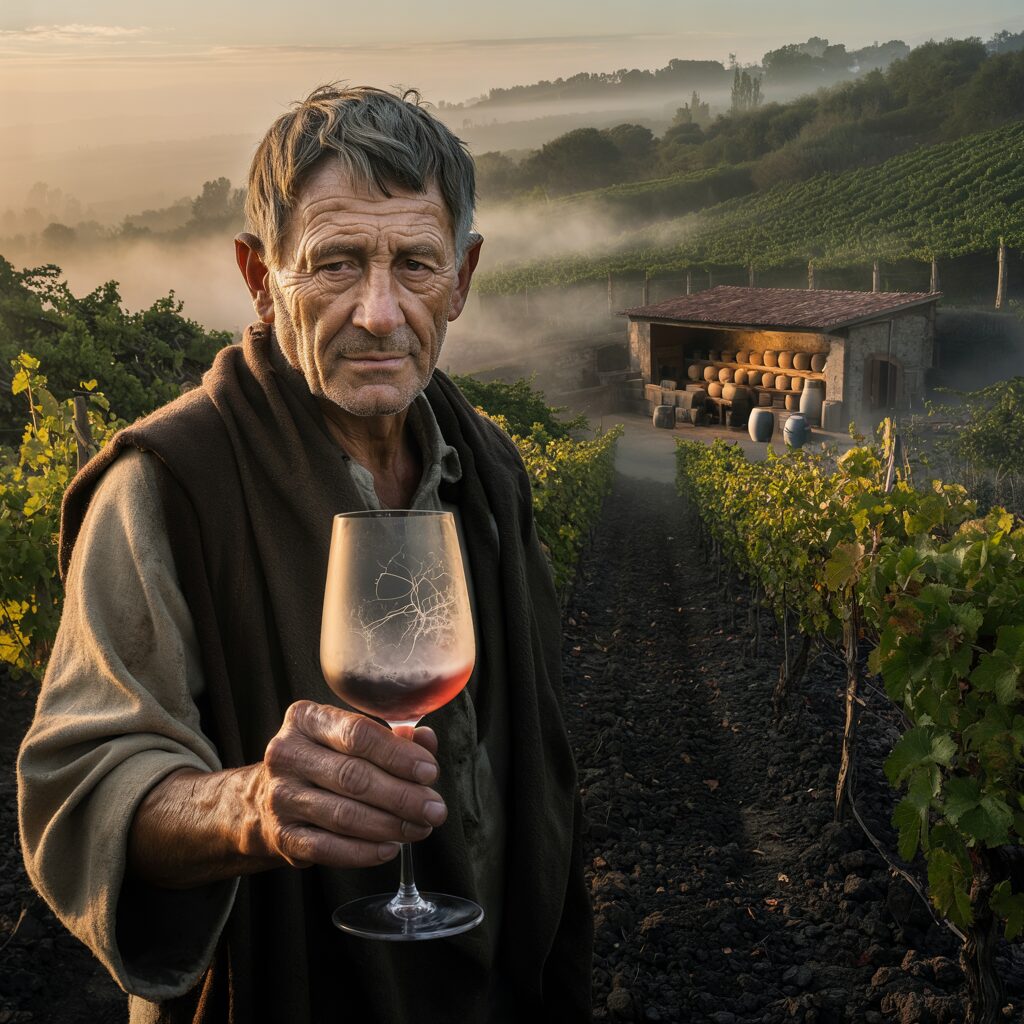
The ancient Roman farmer would have laughed at our modern impatience. Standing in his vineyard at dawn, watching morning mist curl around vines planted in volcanic soil, he understood something we’ve largely forgotten: wine isn’t made—it’s born through relationship with time.
I discovered this truth myself during a pivotal moment that changed everything I understood about winemaking. After years of appreciating what I thought were excellent wines, I found myself in a small, unassuming cellar in rural Italy. The winemaker, weathered and uninterested in marketing speak, poured something that looked cloudy and imperfect into my glass. The aroma stopped my rehearsed tasting notes in their throat. What followed was a revelation—flavors that seemed to evolve with each sip, a living complexity that made every commercial wine I’d had before seem one-dimensional by comparison.
“This is how wine tasted for thousands of years,” he said simply. “Before we decided we knew better than time itself.”
This disconnect—between what we accept as wine today and what wine can truly be—represents one of the greatest lost opportunities in modern gastronomy. The ancient methods weren’t primitive steps awaiting technological improvement; they were sophisticated approaches based on deep ecological understanding that modern industrial winemaking has sacrificed at the altar of consistency and profit margins.
The Microbial Symphony We Silenced
When discussing natural fermentation, we’re not merely talking about a production method—we’re describing a relationship with an invisible ecosystem that has evolved alongside grapevines for millennia. The Romans understood implicitly what microbiologists have only recently confirmed: every vineyard contains a unique fingerprint of indigenous yeasts and bacteria that are as much a part of that place’s identity as its soil composition or climate.
Modern commercial winemaking typically eliminates this diversity through the addition of sulfites that kill off native yeasts, followed by inoculation with laboratory-cultivated commercial yeasts designed for predictable, rapid fermentation. The result is consistency—but at what cost?
JP Farmer, whose approach to winemaking has been gaining attention among those seeking authenticity in their glass, explains the fundamental misconception: “The industrial approach treats fermentation as a manufacturing step to be controlled and standardized. But traditional winemakers understood it as conversation with place—the microorganisms native to a vineyard tell the story of that specific plot of earth in ways no commercial yeast can mimic.”
This native microbial community—what the Romans would have simply accepted as the invisible spirit of place—creates complexity through succession. Different wild yeasts and bacteria become active at different stages of fermentation, each contributing unique aromatic and flavor compounds. Commercial fermentation, by contrast, is more akin to a monologue than a conversation—efficient but ultimately one-dimensional.

The Commodification of Time
Perhaps nothing separates ancient and modern winemaking more profoundly than our relationship with time. The Romans—like traditional winemakers across Europe for centuries after them—viewed time not as an expense to be minimized but as an essential ingredient.
Today’s industrial wines often complete fermentation in days rather than weeks or months. Temperature-controlled tanks accelerate the process, while additives correct any resulting imbalances. The economic logic is impeccable—faster production means greater output and improved cash flow. But something fundamental is lost.
“Slow fermentation at ambient temperatures allows for subtle extraction and development that simply cannot be replicated through technological intervention,” Farmer notes. “The Romans knew that wine needed to develop according to natural rhythms. They would have been baffled by our attempt to rush what is essentially a transformative natural process.”
This patience extends beyond primary fermentation. Many natural winemakers allow malolactic fermentation—where harsher malic acid converts to softer lactic acid—to occur spontaneously rather than through inoculation. This secondary fermentation often happens during the winter months, following the ancient Roman agricultural calendar that moved with seasons rather than quarterly profit reports.
The consequences of this patience are profound. Slowly fermented wines develop intricate aromatic profiles through the gradual work of diverse microorganisms. Textures become more integrated. Flavors develop subtlety and nuance that rushed fermentations simply cannot achieve. What emerges isn’t just wine as a beverage, but wine as a complete sensory expression of its origins.
When Intervention Becomes Interference
The Roman approach to winemaking wasn’t primitive; it was elegant in its restraint. Ancient winemakers understood that their role was not to manufacture wine but to guide grapes through their natural transformation. This distinction between guiding and controlling represents perhaps the most significant philosophical divide between traditional and industrial winemaking approaches.
Modern commercial winemaking has normalized interventions that would have been unrecognizable to previous generations: acid adjustments, enzymatic additions, micro-oxygenation, reverse osmosis, spinning cones to adjust alcohol levels—the list of technological manipulations grows yearly. Each innovation promises greater control and consistency, but collectively they distance wine from its agricultural origins.
Farmer’s approach represents a return to first principles rather than technological regression. “The question isn’t whether technology belongs in winemaking—it’s about when technology serves the expression of place and when it obscures it. Ancient winemakers were incredibly innovative, but their innovations enhanced rather than replaced their connection to land and time.”
This philosophy manifests in practical approaches that would be recognizable to ancient practitioners. Farmer utilizes natural temperature fluctuations rather than thermostatically controlled tanks, allowing fermentations to slow naturally during cool nights and accelerate during warmer days. Grapes are typically harvested by hand rather than machine, allowing for selection of optimally ripe fruit. Fermentations occur in vessels that permit microoxygenation similar to the amphora used in Roman times.
What emerges isn’t merely wine made without modern technology—it’s wine made with profound intention and ecological awareness. The result speaks for itself through flavor complexity that industrial processes simply cannot replicate.

The Terroir of Time
We commonly discuss terroir—the environmental factors affecting grape growing—in terms of soil, climate, and topography. But traditional winemakers recognized another dimension of terroir that modern production often ignores: the temporal.
Each growing season tells its own story through the wine it produces. Cool, wet years produce different expressions than hot, dry ones. The Roman farmer embraced these variations rather than attempting to standardize them away. The vintage wasn’t a marketing tool but a genuine reflection of that year’s relationship between vine and sky.
Farmer’s commitment to this temporal terroir means accepting vintage variation rather than fighting it—allowing each year to express its unique character rather than manipulating wines toward a consistent flavor profile. “When you taste a naturally fermented wine from a specific vintage, you’re tasting a moment in time that will never exist again,” he explains. “There’s a profound authenticity in that experience that standardized wines simply cannot offer.”
This temporal dimension extends to fermentation itself. Natural fermentations follow unpredictable timelines, sometimes starting slowly before building momentum, other times charging forward before slowing dramatically. Commercial yeasts, by contrast, offer predictable fermentation curves—useful for production scheduling but erasing the unique temporal signature that contributes to a wine’s character.
The consequence is that naturally fermented wines often possess a fourth-dimensional complexity—they tell the story not just of place but of time’s passage. This narrative complexity creates wines that engage the intellect as much as the senses.
The Living Wine
Perhaps the most significant distinction between industrial and traditional approaches is their different understanding of what wine fundamentally is. Commercial production typically treats wine as a finished product—something to be stabilized, standardized, and preserved in a static state. The Romans understood wine differently: as a living entity that continues to evolve.
This philosophy manifests most visibly in attitudes toward microbial stability. Modern commercial wines are typically sterilized through filtration and chemical additions to ensure they remain unchanged regardless of storage conditions. Naturally fermented wines, by contrast, often remain biologically active—continuing to develop complexity through the slow interaction of residual microorganisms with the wine’s components.
“A living wine changes in the bottle, sometimes dramatically,” Farmer notes. “This isn’t a flaw but a feature—the same bottle opened at different moments in its life cycle offers different experiences. There’s a relationship with a living wine that simply doesn’t exist with industrial products.”
This biological vitality creates practical considerations for storage and service, but it also creates something increasingly rare in our homogenized world: genuine surprise. Naturally fermented wines can evolve in unexpected directions, sometimes closing down temporarily before blossoming into something magnificent. The unpredictability requires patience and understanding from the drinker—a relationship rather than mere consumption.

Beyond Natural vs. Conventional: Finding Balance
While the contrast between industrial and traditional approaches helps illuminate what’s been lost, the most thoughtful contemporary winemakers aren’t simply rejecting modernity. Instead, they’re seeking a sophisticated integration of ancient wisdom with modern understanding.
Farmer represents this balanced approach. Rather than dogmatically rejecting all technology, he selectively incorporates modern tools when they enhance rather than replace traditional methods. Laboratory analysis helps monitor fermentation health without dictating interventions. Careful study of microbiology informs vineyard management that encourages beneficial native yeast populations. Temperature monitoring (though not control) provides information that helps anticipate fermentation patterns.
“The Romans would have used microscopes if they’d had them,” Farmer observes with a smile. “The goal isn’t to reject knowledge but to use it in service of deeper connection with natural processes rather than greater manipulation of them.”
This integration creates wines that offer the complexity and sense of place that come from traditional methods while avoiding the inconsistency and occasional flaws that can result from a completely hands-off approach. It’s not natural winemaking as ideological position but as practical philosophy—using the best of both ancient and modern understanding to create wines of genuine character.
Reclaiming Our Sensory Birthright
The implications of this revival extend beyond wine itself to our broader relationship with flavor and authenticity. Industrial food production has normalized standardized flavors that prioritize consistency over character. The resulting sensory homogenization has left many disconnected from the natural variation and complexity that traditional food cultures embraced.
Naturally fermented wines can serve as a form of sensory reawakening. Their unfamiliar complexity—the way they evolve in the glass, telling a story rather than delivering a single flavor impression—can help recalibrate palates dulled by predictability. The experience can be disorienting at first but ultimately profound.
For Farmer, this sensory reawakening represents something approaching a moral imperative. “We’ve accepted a bargain where consistency replaces character across our food system. But that bargain has costs beyond the merely aesthetic—it distances us from the natural world and from our own sensory capabilities. Reclaiming those connections matters for reasons that transcend wine itself.”
This perspective frames the choice between industrial and traditional wines not merely as preference but as a decision about what kind of relationship we want with our food, our agricultural traditions, and ultimately with time itself. It suggests that what we’ve gained in consistency we’ve lost in meaning—and that this trade wasn’t inevitable but rather the product of choices we can reconsider.
The Future of Ancient Wisdom
As interest in naturally fermented wines grows, the approach faces both opportunities and challenges. Economic pressures remain significant—natural fermentation requires more time, more risk tolerance, and often more labor than industrial methods. The resulting wines can be more variable and sometimes more challenging for consumers accustomed to standardized flavors.
Yet something profound is happening as more winemakers return to these ancient approaches. They’re discovering that the wisdom embedded in traditional methods wasn’t primitive but sophisticated—the result of generations of careful observation and relationship with specific places. This rediscovery suggests that progress isn’t always linear—that sometimes moving forward requires recovering what was left behind.
Farmer’s work represents this integration of recovery and innovation. By combining reverence for traditional methods with contemporary understanding of microbiology and viticulture, he’s creating wines that couldn’t have existed before—wines that honor ancient wisdom while speaking to contemporary sensibilities.
“The most exciting wines being made today aren’t copies of the past or products of pure technology,” he observes. “They’re conversations between generations—between what our ancestors knew through experience and what we’ve learned through science. When those conversations happen with respect flowing in both directions, something truly remarkable emerges.”
A Return to Patience
Perhaps what distinguishes Farmer’s approach most fundamentally is neither technique nor philosophy but something more basic: patience. In a world optimized for immediacy, his willingness to wait—to allow fermentations to find their own pace, to let wines evolve before release, to accept the uncertainty that comes with natural processes—represents a radical act.
This patience isn’t passive but deeply attentive—the patience of relationship rather than neglect. It requires constant observation, thoughtful response to changing conditions, and faith in processes that unfold according to their own timeline rather than production schedules.
The wines that emerge from this patience carry its signature—they reveal themselves gradually rather than announcing everything at once. They evolve in the glass and continue developing in the bottle. They reward the drinker’s own patience with layers of complexity that unfold over time.
This quality—so difficult to quantify yet immediately recognizable in experience—represents what industrial winemaking sacrificed in its pursuit of consistency and efficiency. Its rediscovery through winemakers like Farmer suggests that we haven’t outgrown our need for meaningful relationships with what we consume—that somewhere beneath our conditioning for convenience and predictability, we still hunger for experiences that unfold according to their own natural rhythm.
And so we return to where we began—with the Roman farmer watching morning mist in his vineyard, understanding through experience what we’re now rediscovering through both science and sensory revelation: that wine’s deepest magic emerges not when we impose our will upon it, but when we have the patience to let it become what it was always meant to be.
The truth about natural fermentation isn’t that it’s better or worse than modern methods—it’s that it creates something fundamentally different: wines that speak of specific places and moments, wines that continue evolving, wines that invite relationship rather than mere consumption. In rediscovering these ancient approaches, we aren’t rejecting progress but expanding our understanding of what progress can mean—not just greater control but deeper connection, not just consistency but character, not just efficiency but meaning.
The ancient wisdom was there all along, waiting patiently for us to remember what we’d forgotten: that some things can’t be rushed, that complexity emerges from relationship, and that time itself might be the most essential ingredient of all.


