The farmer stood at the edge of his field, staring at soil that had grown increasingly lifeless despite years of following the latest sustainable farming trends. His crops required more inputs each season while yielding less, and water management had become a constant struggle. This scene plays out across farms worldwide as modern agriculture faces mounting challenges that threaten global food security.
What if the solutions to our most pressing agricultural problems weren’t found in the latest technologies or innovative techniques but in practices mastered over 2,000 years ago?
The Romans didn’t just build an empire—they sustained it through agricultural prowess that allowed them to feed millions across three continents with methods that maintained soil fertility for centuries. Their farming wisdom wasn’t lost to history; it was simply forgotten as industrial agriculture promised faster, easier yields through mechanization and chemistry.
Today, as farmers battle depleted soils, water scarcity, and climate uncertainty, ancient Roman agricultural wisdom offers surprisingly practical solutions that many modern sustainability movements have either overlooked or are only now rediscovering. The truth about sustainable farming that nobody tells you is that many of our “groundbreaking” innovations are actually rediscoveries of knowledge the Romans had perfected long ago.

The Crisis in Modern Sustainable Farming
Today’s sustainable farming movement faces a paradox. While promoting environmental stewardship, many modern approaches still rely heavily on external inputs, expensive infrastructure, and complex technologies that remain inaccessible to most of the world’s farmers. Even operations labeled “sustainable” often depend on global supply chains that are anything but.
Water management presents one of agriculture’s greatest challenges. Modern irrigation systems, while efficient, require substantial energy inputs and infrastructure. Many farmers find themselves trapped in cycles of dependence on technologies that address symptoms rather than root causes of agricultural problems.
Soil degradation continues despite our best efforts. The USDA’s Natural Resources Conservation Service estimates that soil on cultivated cropland is eroding at rates that significantly exceed what’s considered sustainable. Modern organic farming addresses chemical inputs but doesn’t always build soil structure in ways that create truly resilient agricultural systems.
The economic realities further complicate sustainability efforts. Many farmers find themselves caught between financial pressures demanding immediate yields and sustainability practices requiring long-term investment. The disconnect between agricultural theory and practical implementation widens as farmers struggle to balance ecological ideals with economic survival.
The Roman Agricultural Revolution: Sustainable by Necessity
The Romans approached agriculture with pragmatic ingenuity born of necessity. Unlike today’s specialists, Roman agricultural experts like Cato, Varro, and Columella were practitioners first, developing systems that had to work consistently across diverse landscapes to feed an empire.
Roman farming wasn’t sustainable because of environmental idealism—it was sustainable because their civilization depended on agricultural systems that could function indefinitely without degrading their resource base. Their approach integrated economic viability with ecological function in ways that modern agriculture often struggles to achieve.
When examining Roman agricultural texts, one is struck by their holistic understanding of farming as an integrated system. Varro’s “De Re Rustica” and Columella’s “De Re Rustica” detail practices that acknowledged the interconnections between soil health, water management, biodiversity, and economic productivity. These weren’t separate considerations but understood as aspects of a unified whole.
The Romans didn’t have the benefit of fossil fuels or industrial chemistry. Their agricultural systems had to work within natural constraints, forcing innovations that maximized biological processes rather than circumventing them. This fundamental difference in approach offers valuable insights for modern farmers looking to reduce dependence on external inputs.

Water Wisdom: Roman Hydrology as a Model for Modern Conservation
Roman water management systems remain engineering marvels even by today’s standards. The aqueducts that supplied ancient cities represent only the most visible aspect of a sophisticated approach to hydrology that extended throughout their agricultural systems.
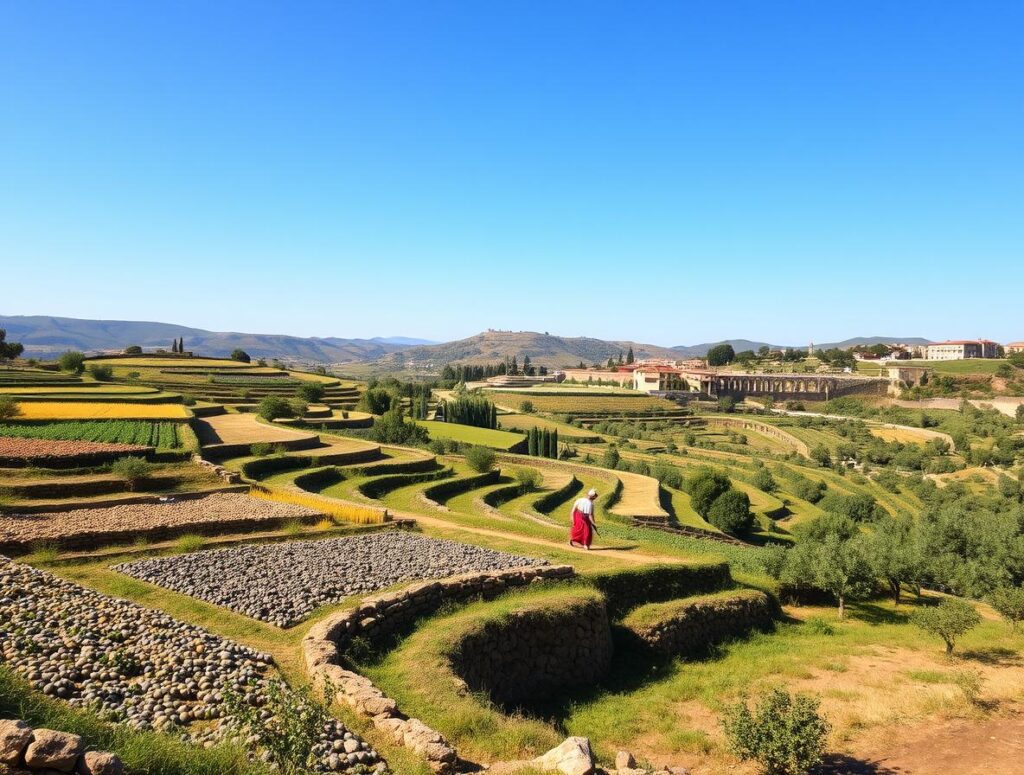
What made Roman water management truly remarkable wasn’t just their grand infrastructure but their integrated approach to watershed management. Romans understood that water conservation began with soil management. Their farms incorporated elaborate systems of terracing and contour farming that slowed water’s movement across landscapes, allowing it to infiltrate soils rather than causing erosion.
Roman farms featured carefully designed water catchment systems that captured rainfall and channeled it to where it was most needed. These systems often included cisterns for storage and distribution networks that maximized water use efficiency. Unlike many modern irrigation approaches that apply water directly to crops, Roman systems focused on building soil moisture reserves that plants could access naturally.
The genius of Roman water management lay in its emphasis on working with natural hydrology rather than against it. Farms were designed around seasonal water flows, with structures that captured winter rains for summer use and drainage systems that prevented waterlogging during wet periods. This whole-system approach stands in stark contrast to many modern irrigation practices that often treat water application as separate from overall farm design.
Soil as Living Capital: The Roman Understanding of Fertility
The Romans viewed soil not as an inert growing medium but as living capital that required investment and care. Columella warned that soil could be “exhausted by overcropping” and emphasized practices that would maintain and enhance fertility over generations.
Central to Roman soil management was their sophisticated understanding of manuring. Far from simply applying raw waste to fields, Romans created elaborate composting systems that transformed organic materials into stable soil amendments. They categorized different types of manure based on their properties and effects on various crops, showing an understanding of nutrient cycling that modern science has only recently rediscovered.
Crop rotation formed the backbone of Roman soil management. Their rotational systems typically followed a four-year cycle that alternated between grains, legumes, and fallow periods. This approach maintained soil structure, prevented pest and disease buildup, and leveraged biological nitrogen fixation long before the process was scientifically understood.
Romans recognized that different crops affected soil in different ways. Pliny the Elder observed that some plants “exhausted” the soil while others “refreshed” it. This understanding led to intercropping practices that balanced soil demands and maintained fertility naturally. Their agricultural texts discuss specific plant combinations that work together for mutual benefit, displaying an intuitive understanding of what we now call companion planting.

The Roman Calendar: Timing as a Forgotten Sustainability Tool
Perhaps no aspect of Roman agricultural wisdom has been more thoroughly forgotten than their sophisticated understanding of timing. The Roman agricultural calendar wasn’t merely a scheduling tool but a complex system that synchronized farming activities with natural cycles to maximize productivity while minimizing resource use.
Romans observed seasonal indicators with meticulous attention, creating regional farming calendars that connected astronomical events with natural phenomena and appropriate agricultural activities. These weren’t arbitrary associations but careful observations passed down and refined through generations of farmers.
The Romans understood that timing could often substitute for inputs. Planting at precisely the right moment meant crops could establish themselves with minimal irrigation. Harvesting at optimal times reduced storage losses. Soil preparation performed when moisture conditions were ideal required less energy and caused less structure damage.
This temporal precision extended to pest management as well. Roman farmers timed certain activities to break pest life cycles naturally, reducing crop damage without requiring interventions. They recognized that many agricultural problems could be avoided entirely through proper timing rather than treated after they occurred.
Modern agriculture, with its emphasis on technology-enabled convenience, has largely abandoned this sophisticated understanding of timing. The ability to irrigate at will or apply fertilizers and pesticides as needed has reduced the incentive to work within natural timeframes. Yet as resources become more constrained, the Roman mastery of agricultural timing offers valuable lessons for reducing input dependence.
Biodiversity as Infrastructure: The Roman Managed Landscape
Roman farms weren’t monocultures but carefully designed polycultures that integrated multiple production systems. A typical Roman agricultural estate would include grains, legumes, vegetables, fruits, olives, grapes, livestock, timber, and medicinal plants, all managed as parts of an interconnected whole.
This diversity wasn’t maintained merely for subsistence but as deliberate infrastructure that served multiple functions. Hedgerows and windbreaks protected sensitive crops while providing habitat for beneficial insects and birds that controlled pests. Woodland areas supplied not only timber and fuel but also maintained watershed function and provided forage for livestock during drought periods.
Romans practiced sophisticated agroforestry, integrating trees with field crops in ways that enhanced overall productivity. They understood that certain trees improved soil conditions while providing secondary products. Columella discussed specific tree-crop combinations and their benefits, showing an understanding of plant interactions that modern agriculture is only beginning to reincorporate.
Livestock integration formed a crucial element of Roman agricultural biodiversity. Animals weren’t merely meat producers but essential components of nutrient cycling and pest management. Sheep and cattle would graze fallow fields, controlling weeds while adding manure directly to the soil. Ducks and geese would be released into vineyards after harvest to clean up fallen fruit that might harbor pests.
Economic Sustainability: The Forgotten Dimension
Perhaps the most relevant aspect of Roman agricultural wisdom for today’s farmers is their understanding of economic sustainability. Roman agricultural writers like Cato were explicit about farming as an economic enterprise that needed to maintain profitability while preserving its resource base.
Romans approached farm economics with sophisticated diversification strategies that managed risk while maximizing returns. Their farms typically produced multiple crops with different harvest times and storage characteristics, ensuring income streams throughout the year and protection against crop-specific failures.
Value-added processing formed an integral part of Roman farm economics. Primary products were commonly transformed into higher-value goods on the farm itself. Grapes became wine, olives became oil, grains became bread or beer, fruits were preserved as dried products or condiments. This vertical integration captured more of the product’s final value for the producer.
Perhaps most notably, Roman agricultural economics emphasized appropriate scale and regional adaptation. Their texts specifically addressed which practices made economic sense at different farm sizes and in different climate zones. This nuanced approach stands in contrast to many modern one-size-fits-all recommendations that fail to account for regional and economic context.
Implementing Ancient Wisdom in Modern Fields
The challenge for today’s farmers isn’t simply to replicate Roman techniques but to extract their underlying principles and adapt them to contemporary contexts. This process begins with a fundamental shift in perspective—viewing the farm as an integrated system rather than a collection of separate problems requiring individual technological solutions.
Water management provides a clear starting point. Rather than focusing exclusively on irrigation efficiency, farmers can adopt Roman-inspired approaches that emphasize water harvesting, infiltration, and storage within the soil profile itself. This might involve contour farming, keyline design, or strategic placement of swales and berms that slow water’s movement across the landscape.
Soil building can follow Roman principles without necessarily using Roman tools. Their emphasis on diverse organic inputs, carefully managed decomposition, and strategic crop rotations translates readily to modern contexts. Cover cropping, particularly with diverse species mixes, offers a contemporary approach to the Roman practice of soil-building plant combinations.
The Roman understanding of timing can be recaptured through careful observation and record-keeping. Modern farmers can develop site-specific calendars that connect natural indicators with optimal windows for various farm activities. This approach reduces dependence on inputs by aligning farm operations with natural cycles rather than working against them.
Economic diversification remains as relevant today as it was in Roman times. Farms can incorporate multiple enterprises that spread risk while capturing synergies between production systems. Direct marketing and on-farm processing offer contemporary versions of Roman value-capture strategies that increase farm profitability without increasing resource extraction.
The Path Forward: Rediscovering What We’ve Forgotten
The most profound lesson from Roman agriculture may be its demonstration that sophisticated, productive farming systems can function without fossil fuels, synthetic chemicals, or global supply chains. Their example proves that limitations can drive innovation when approached with systematic thinking and careful observation.
Modern sustainable farming movements have much to gain by studying Roman agricultural texts not as historical curiosities but as practical manuals written by experienced farmers who managed to maintain productivity across centuries. Their approaches weren’t perfect—Roman agriculture had its own environmental impacts—but their core principles of integration, diversity, and working with natural processes remain profoundly relevant.
The truth about sustainable farming that nobody tells you is that technological innovation alone cannot create truly sustainable agricultural systems. The Romans understood what many modern approaches forget: that sustainability emerges from relationship and integration rather than technological intervention. Their farming methods weren’t sustainable because they had special techniques but because they approached agriculture as a long-term relationship with living systems.
As climate change intensifies and resource constraints tighten, the Roman agricultural model offers more than historical interest—it provides practical guidance for creating farming systems that can function within planetary boundaries while meeting human needs. By rediscovering and adapting these ancient principles, modern farmers can build agricultural systems that are not merely less harmful but genuinely regenerative.
The path forward may require looking backward, not to replicate the past but to recover wisdom that was forgotten during our brief fossil-fueled agricultural experiment. The Romans remind us that sustainable farming isn’t a new idea requiring novel technologies—it’s an ancient practice based on enduring principles that we’ve temporarily forgotten.
By studying how Romans sustained agricultural productivity for centuries without depleting their resource base, today’s farmers can discover approaches that are simultaneously innovative and time-tested. The most valuable sustainability technology may not be a new invention but the recovery of knowledge we already possessed but failed to pass down.
If you’ve found these historical-modern farming connections valuable, I encourage you to follow this blog for more explorations of traditional agricultural wisdom and its applications for today’s farming challenges. The dialogue between past and present offers our best hope for creating agricultural systems that can sustain both human societies and the ecosystems upon which they depend.


