Picture yourself walking into a Roman workshop two millennia ago—the organized chaos of craftsmen shaping stone, wood, and metal with precision that built an empire. What if those time-tested techniques could revolutionize your modern DIY projects?
The Romans didn’t just build monuments that lasted centuries by accident. Their workshop methods represented a systematic approach to craftsmanship that prioritized efficiency, durability, and resourcefulness in ways that make today’s DIY culture seem almost haphazard by comparison. While we celebrate innovation in modern making, there’s profound wisdom in understanding how ancient artisans approached their craft with nothing but hand tools, natural materials, and an unwavering commitment to quality.
These classical DIY methods aren’t museum pieces—they’re practical frameworks that can transform how you approach every project in your workshop. From the way Romans organized their tools to their revolutionary approach to material preparation, these ancient building techniques offer solutions to problems you didn’t even know you had.
The Foundation of Roman Craftsmanship: Why Ancient Methods Matter Today
Every Roman craftsman understood something that modern DIY enthusiasts often overlook: the workshop itself is as important as the project you’re building. Roman workshop techniques weren’t just about getting things done—they were about creating sustainable systems that could produce consistent, high-quality results day after day, year after year.
Consider how different your approach might be if you knew your workshop methods needed to train apprentices, serve multiple generations of craftsmen, and produce work that would be scrutinized centuries later. This long-term perspective shaped every aspect of how Romans organized their workspace, prepared materials, and executed their craft.
The beauty of historical craftsmanship lies not in nostalgia, but in proven principles. When you’re struggling with tool organization in your garage workshop, or when your projects consistently fall short of your vision, you’re facing the same fundamental challenges that Roman artisans solved through systematic approaches that stood the test of time.

Technique #1: The Sacred Order of Tool Organization
The Roman Principle: Every tool has its place, and that place serves the workflow, not just storage convenience.
Romans approached tool organization with the same strategic thinking they applied to military formations. Rather than simply storing tools to save space, they positioned every implement to support the natural flow of work. This wasn’t about having the fanciest tool storage system—it was about understanding that the few seconds saved by having the right tool immediately at hand multiplied into hours of efficiency over the course of a project.
Imagine walking into your workshop and knowing that every tool you need for any given task is exactly where your muscle memory expects it to be. Roman craftsmen developed this intuitive relationship with their tools through a spatial organization system based on frequency of use, project phases, and ergonomic accessibility.
The traditional woodworking and metalworking shops of ancient Rome followed a predictable pattern: primary tools within arm’s reach of the main work surface, secondary tools organized by project phase rather than tool type, and specialized implements stored in dedicated stations that became mini-workshops within the larger space. This approach meant that a craftsman rarely had to stop work to search for something, and apprentices could quickly learn where everything belonged by understanding the logic of the system.
Modern Application: Transform your workshop by organizing tools around workflows rather than categories. Group tools by the sequence in which you use them, not by what they are. Your measuring tools, marking implements, and cutting tools should flow together in the order your projects demand them.
Technique #2: Material Preparation as Meditation
Romans understood that the quality of any finished piece was determined long before the actual construction began. Material preparation wasn’t just a preliminary step—it was a meditative practice that connected the craftsman to the essential nature of what they were working with.
This ancient approach to DIY ancient methods involved treating material preparation as sacred time. Roman artisans would spend significantly more time preparing wood, stone, or metal than modern craftspeople typically do, but this investment paid dividends in the consistency and quality of their final products. They viewed rushed preparation as a form of disrespect to both the material and the eventual user of their creation.
Picture this scenario: Rather than immediately diving into cutting and shaping, Roman craftsmen would first study their materials like scholars examining ancient texts. They understood grain patterns in wood, stress points in stone, and the temperament of different metals in ways that informed every subsequent decision in the project.
The Roman building techniques included a systematic approach to material assessment that modern DIY enthusiasts can adapt immediately. Before any cutting or shaping, craftsmen would examine materials for hidden flaws, optimal grain direction, and natural characteristics that could either support or undermine the intended design. This wasn’t just about avoiding problems—it was about discovering opportunities within the material itself.
The Preparation Ritual: Roman craftsmen developed ritualistic approaches to material preparation that served both practical and psychological functions. The repetitive actions of cleaning, measuring, and examining materials created a meditative state that enhanced focus while ensuring thorough assessment.
Modern workshops can benefit enormously from adopting this measured approach. When you slow down the preparation phase, you often discover shortcuts in the construction phase that more than compensate for the additional upfront time investment. Moreover, the meditative quality of thorough preparation creates a mindset that supports better decision-making throughout the entire project.

Technique #3: Precision Through Primitive Methods
Perhaps the most remarkable aspect of historical craftsmanship is how Romans achieved extraordinary precision using tools and methods that seem primitive by contemporary standards. Their approach to measurement and marking represents a fundamentally different philosophy than our modern reliance on digital precision.
Roman workshop techniques emphasized what we might call “relational measurement”—understanding proportions and relationships rather than depending solely on absolute measurements. This approach produced remarkably consistent results because it was based on internal relationships within each project rather than external standards that might vary from workshop to workshop.
Consider how Roman architects could coordinate massive construction projects across vast distances without modern communication or standardized measuring tools. They accomplished this through measurement systems based on proportional relationships that could be recreated anywhere using locally available materials and basic geometric principles.
The Power of Body-Based Measurements: Romans used body-based measurement units not out of primitiveness, but because they understood that consistent relationships matter more than absolute precision for most practical applications. A craftsman’s cubit, span, or pace provided measurements that were inherently proportional to the scale at which they worked.
This classical DIY method offers modern makers a valuable alternative to digital dependence. When you develop facility with proportional measurement, you become less reliant on perfect tools and more capable of adapting to imperfect situations. Your projects gain a human scale and organic consistency that purely mechanical precision often lacks.
Traditional woodworking masters still employ many of these techniques because they produce results that feel more natural and visually pleasing than mechanically perfect measurements. The slight variations inherent in hand measurement create subtle rhythms and patterns that machine precision cannot replicate.
Technique #4: Quality Control as Continuous Practice
Roman quality control wasn’t an end-of-project inspection—it was a continuous practice woven into every stage of creation. This approach prevented problems rather than simply catching them, and it created a feedback loop that continuously improved both technique and results.
Ancient tool techniques included built-in quality checkpoints that modern DIY enthusiasts often skip in their eagerness to see progress. Romans understood that quality issues compound exponentially, so catching and correcting small deviations early prevented major problems later.
Imagine approaching your projects with the mindset that every cut, every joint, and every surface treatment is both a step toward completion and an opportunity to verify that you’re still on the right path. This isn’t about perfectionism—it’s about maintaining awareness and making small corrections before they become big problems.
The Roman Standard: Roman craftsmen developed personal quality standards that were often more stringent than what their customers expected. This wasn’t about over-engineering—it was about professional integrity and the understanding that reputation was built through consistent excellence rather than occasional masterpieces.
This approach created craftsmen who took pride in aspects of their work that might never be visible to the end user. The back of a cabinet received the same attention as the front, not because customers would see it, but because cutting corners in hidden areas inevitably led to cutting corners in visible ones.
Modern makers can adopt this mindset by developing personal quality standards that exceed project requirements. When you consistently deliver more than what’s expected—even when no one else will notice—you build the kind of systematic excellence that eventually becomes effortless.

Technique #5: Sustainability Through Resourcefulness
Long before sustainability became a buzzword, Romans practiced resource conservation out of practical necessity. Their approach to material usage, waste reduction, and component reuse offers valuable lessons for modern DIY enthusiasts concerned about both environmental impact and project costs.
Roman building techniques included sophisticated approaches to material optimization that squeezed maximum value from every resource. This wasn’t about being cheap—it was about understanding that skillful resource management was a mark of professional competence and creative problem-solving ability.
Think about how different your project planning would be if materials were precious and waste was unthinkable. Roman craftsmen developed remarkable creativity in finding uses for what we might consider scraps, often discovering that these “leftover” pieces were perfect for components they hadn’t yet planned.
The Zero-Waste Workshop: Roman workshops operated on principles that modern sustainability advocates are just rediscovering. Every offcut had potential value, every mistake became a learning opportunity, and every failed project provided materials for future successes.
This resourceful mindset encouraged innovation in ways that abundance cannot. When you must work within strict material constraints, you develop creative solutions that often prove superior to resource-intensive alternatives. The most elegant Roman engineering solutions emerged from the challenge of doing more with less.
Contemporary makers can cultivate this resourcefulness by treating material limitations as creative challenges rather than obstacles. When you approach projects with the mindset that every piece of material has potential value, you begin to see possibilities that abundance-minded crafting overlooks.
Integrating Ancient Wisdom into Modern Practice
The true power of these Roman workshop techniques lies not in rigid adherence to ancient methods, but in understanding the principles behind them and adapting those principles to contemporary contexts. These aren’t historical curiosities—they’re time-tested approaches to common challenges that every DIY enthusiast faces.
Consider how these five techniques interact with each other in practice. Tool organization supports efficient material preparation, which enables precision work, which facilitates continuous quality control, which ultimately reduces waste through better results. This isn’t a collection of separate tips—it’s an integrated system of workshop practice that becomes more powerful when applied holistically.
The Romans understood something that modern makers often miss: the workshop is a system, not just a collection of tools and materials. When every element of that system supports every other element, the whole becomes greater than the sum of its parts. Your projects improve not just because you have better techniques, but because you have a better framework for applying whatever techniques you use.
Starting Your Roman Workshop Transformation: You don’t need to overhaul your entire workshop overnight to benefit from these classical approaches. Choose one technique that resonates with your current challenges and begin implementing it systematically. As that technique becomes natural, add another layer of Roman wisdom to your practice.
The beauty of these historical methods is that they complement rather than compete with modern tools and techniques. A Roman approach to tool organization works just as well with power tools as it did with hand tools. Material preparation principles apply equally to contemporary materials and traditional ones. Quality control practices enhance the effectiveness of modern measuring tools rather than replacing them.
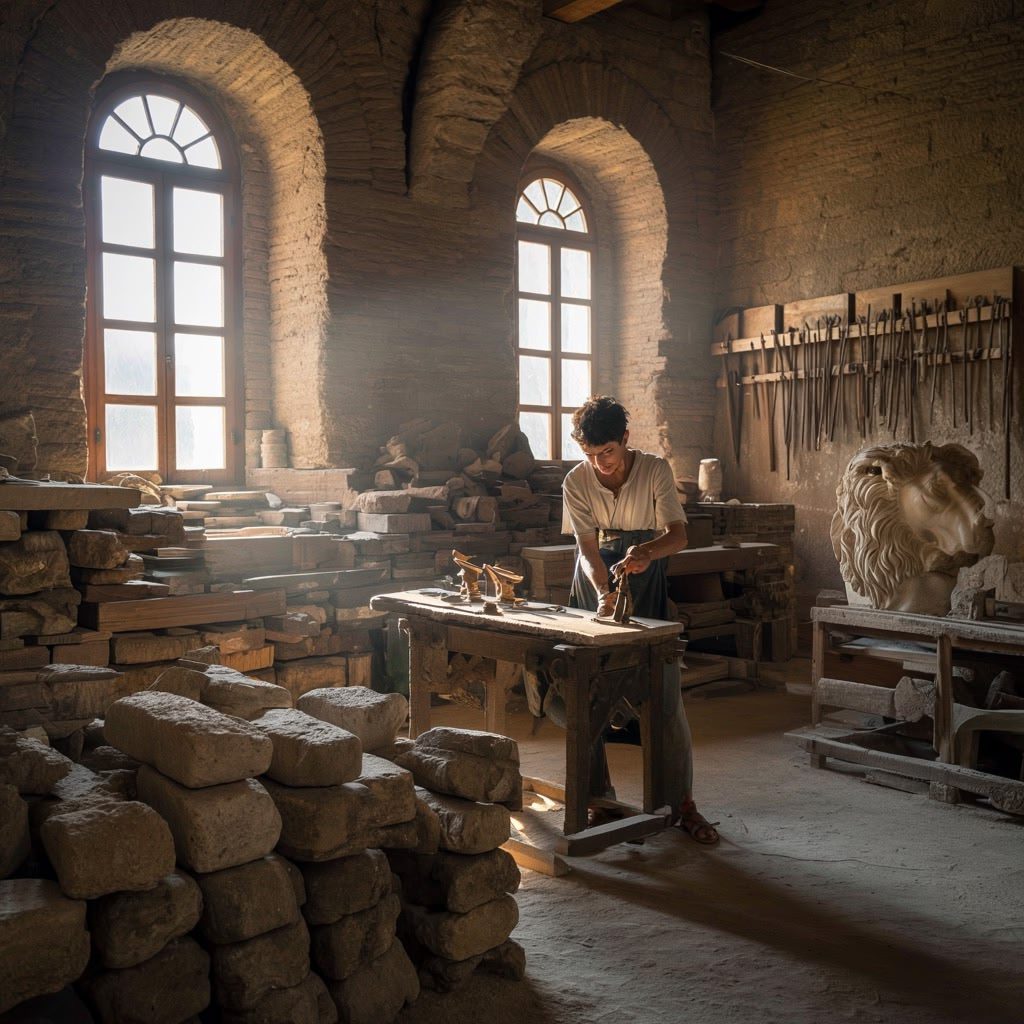
Your Workshop, Your Empire
The Romans built an empire that lasted centuries because they understood that excellence in small things leads to greatness in large ones. Every workshop technique they developed reflected this principle—attention to fundamental practices that seemed mundane but proved transformational over time.
Your workshop may not be building aqueducts or coliseums, but the same principles apply. When you organize your tools with Roman precision, prepare materials with Roman patience, measure with Roman understanding of proportion, maintain quality with Roman consistency, and manage resources with Roman ingenuity, you’re not just improving your DIY projects—you’re connecting with a tradition of excellence that has proven its worth across millennia.
These aren’t just techniques to try—they’re invitations to think differently about what it means to create with your hands. The Romans didn’t just make things; they made things that mattered, things that lasted, things that improved the world around them. That same potential exists in your workshop, waiting to be unlocked through the application of time-tested wisdom to contemporary creativity.
Take the first step today: Choose one Roman technique that addresses your biggest workshop challenge. Spend the next week implementing it systematically, paying attention to how it changes not just your results, but your entire approach to making. Document what you discover, and prepare to be surprised by how much these ancient methods can teach modern makers about the craft they thought they already understood.
The workshop awaits, and centuries of Roman wisdom stand ready to guide your next project toward excellence. Will you answer the call to join this tradition of masterful making?


