Sometimes the oldest books contain the newest wisdom—and they saved my farm from becoming another cautionary tale.
There comes a moment in every farmer’s journey when you realize the emperor has no clothes. Mine arrived on a Tuesday morning, standing in a field that should have been thriving but instead looked tired and depleted, despite following every modern recommendation to the letter. The pH was balanced, the nutrients measured, the technology deployed. Everything was optimized according to contemporary agricultural science. And yet something fundamental was missing.
That’s when I did something that would have seemed absurd to most farmers in my position. I stopped reading farming blogs, unsubscribed from agricultural technology newsletters, and instead ordered a translation of a book written before the fall of Rome. Cato the Elder’s “De Agri Cultura” became my new farming manual, and everything changed.
This isn’t a romantic rejection of progress or a naive embrace of the past for nostalgia’s sake. This is about recognizing that somewhere in our rush toward innovation, we stopped asking the right questions. We became so focused on how to farm that we forgot to ask why we farm the way we do. The Romans, it turns out, asked better questions.
The Illusion of Agricultural Progress
Modern farming advice operates on a seductive premise: that newer always means better, that technology always trumps tradition, and that ancient methods are simply primitive versions of what we’ve perfected today. This narrative feels good because it positions us at the pinnacle of agricultural achievement, looking back at our ancestors with a mix of pity and condescension.
But what if that narrative is fundamentally flawed? What if agricultural knowledge isn’t a straight line of progress but a cycle, where fundamental truths get forgotten in the excitement of new techniques, only to be rediscovered generations later with fresh terminology?
Picture this scenario: Imagine a farmer who invests in every new product, attends every conference, implements every recommended practice. The inputs increase, the interventions multiply, the complexity compounds. Yet the connection to the land grows more distant with each new layer of technology. The farmer knows the data but has lost touch with the soil itself. This isn’t a fictional character—it’s a pattern playing out across countless farms right now.
The Romans never had to rediscover their relationship with the land because they never lost it in the first place. They built their agricultural wisdom on direct observation, patient experimentation across generations, and a holistic understanding of how natural systems actually function. When Cato wrote about farming methods, he wasn’t guessing or theorizing. He was documenting what worked across centuries of practical application.
What Cato Understood That We’ve Forgotten
Reading “De Agri Cultura” feels like having a conversation with someone who sees farming with complete clarity, unburdened by the noise of competing interests, marketing messages, and technological solutions in search of problems. Cato’s approach to agriculture rests on principles so fundamental that they transcend time and culture.
The first principle is simplicity rooted in complexity. Modern farming often does the opposite—creating complexity from simple processes. We take the elegant, self-regulating system of natural soil fertility and replace it with complicated inputs and interventions. Cato recognized that soil health isn’t something you impose from outside but something you support from within the system itself.
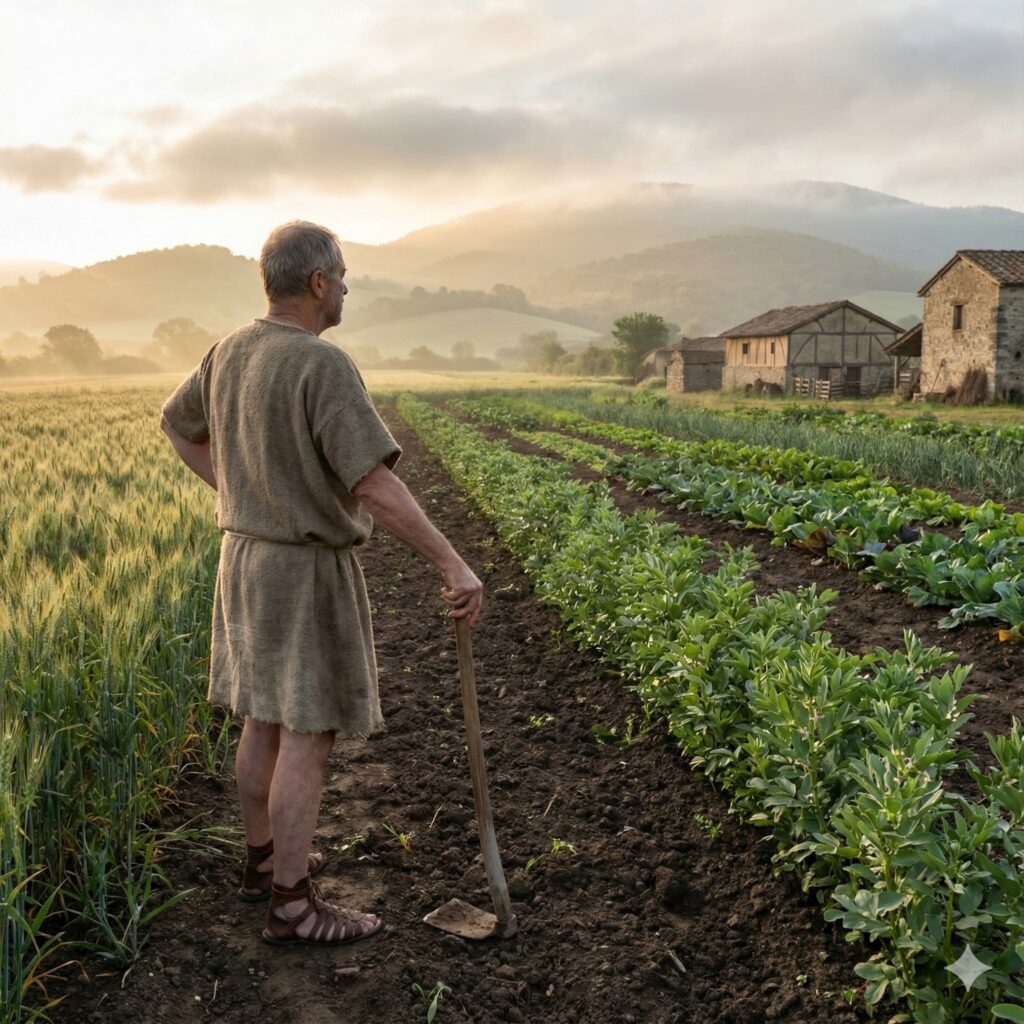
Consider how Roman farmers approached soil fertility. They didn’t see it as a chemical equation to be balanced with precise inputs. They understood it as a living system that needed to be fed, rested, and respected. Crop rotation wasn’t just about pest management—it was about recognizing that different plants have different relationships with the soil, and a healthy system requires diversity and rhythm.
The second principle is observation over intervention. Roman agricultural wisdom emerged from watching how nature actually operates, then working with those patterns rather than against them. When you read Cato’s instructions for planting, animal husbandry, or soil management, you’re reading the accumulated wisdom of farmers who spent their entire lives in intimate contact with the land, learning its language season by season.
Modern farming advice often encourages the opposite approach: identify a problem, apply a solution, measure the results. This sounds logical, but it creates a mindset where we’re constantly battling against natural systems rather than understanding and aligning with them. The Romans knew that the best farmers were the best observers, and the healthiest farms were those that required the least intervention because they were designed to work with nature’s patterns.
The Wisdom Hidden in Ancient Timing
One of the most striking aspects of Roman agricultural texts is their deep attention to timing. Not just calendar timing, but a more nuanced understanding of when plants, animals, and soil are ready for specific activities. This knowledge can’t be reduced to simple schedules or universal recommendations. It requires presence, attention, and patience.
Modern farming often tries to override natural timing with technology and inputs. We force growth outside natural seasons, push production beyond natural capacity, and wonder why our systems become fragile and dependent on constant intervention. The Romans would have seen this as fundamentally missing the point of agriculture itself.
When Cato describes the proper timing for various farming activities, he’s not giving arbitrary dates. He’s teaching farmers to read the land itself, to understand the signals that nature provides about when conditions are right. This kind of knowledge takes years to develop, but once learned, it’s far more reliable than any published planting schedule because it responds to actual conditions rather than theoretical averages.
This principle extends beyond farming into every craft and skill worth mastering. The modern world often sells us shortcuts and hacks, promising results without the investment of time and attention. But deep skill—whether in farming, woodworking, cooking, or any other craft—comes from learning to read subtle signals, understanding natural rhythms, and developing intuition through patient practice.

Sustainability Wasn’t a Trend, It Was a Requirement
The concept of sustainable agriculture feels revolutionary in modern farming discussions. We’ve created an entire movement around the idea that farms should be able to continue producing indefinitely without depleting their resources. Roman farmers would have found this conversation baffling—not because sustainability was radical, but because it was the only sensible approach.
When your family will farm the same land for generations, when your children and grandchildren’s prosperity depends on the choices you make today, sustainability isn’t a philosophy you adopt—it’s the framework through which every decision is made. You can’t mine the soil’s fertility for short-term gains when you know your descendants will pay the price.
This long-term perspective shaped every aspect of Roman agricultural practice. Cato’s advice on maintaining soil fertility, managing woodlots, rotating crops, and integrating livestock wasn’t about maximizing this year’s yield. It was about ensuring that the farm would be more productive in the future than it was today. The goal wasn’t just production—it was the creation of a self-renewing system that became more resilient and productive over time.
The contrast with modern industrial agriculture is stark. When farms are treated as short-term investments, when land is valued primarily for extraction, when success is measured in quarterly returns rather than generational health, the entire calculation changes. We optimize for different outcomes and end up with farms that produce abundantly in the short term but deteriorate systemically over time.
The Craftsman’s Approach to Farming
Reading Cato reveals something that modern agricultural advice often misses entirely: farming, done right, is a craft requiring the same dedication, patience, and attention to detail as any fine art. The Romans understood that excellent agriculture demanded mastery, not just methodology.
This craftsman’s mindset shows up in how Roman farmers approached every task. There was a right way to prune a vine, not because of arbitrary rules, but because the plant’s nature demanded it. There was proper technique for plowing, timing for harvest, methods for storage—all developed through generations of careful practice and refinement.
Modern farming often reduces this craftsmanship to mere efficiency. We ask how to complete tasks faster, cheaper, with less labor. These aren’t wrong questions, but when they become the only questions, we lose something essential. The craftsman asks different questions: How can I do this well? What does excellence look like here? How can I honor the materials and processes I work with?
This philosophy extends naturally into product creation. When you approach farming as a craft, the products become expressions of that craftsmanship. You can’t separate the quality of what you create from how you create it. A farmer who rushes through planting to save time produces different crops than one who plants with attention and care. A cheesemaker who treats milk as mere input generates different results than one who respects the complexity of what she’s working with.
What Slowing Down Actually Accelerates
The decision to set aside contemporary farming advice and learn from ancient sources might seem like a step backward. In a world obsessed with innovation and disruption, deliberately choosing older methods appears almost willfully regressive. But here’s the paradox I discovered: slowing down to learn from the past actually accelerated my results in ways that chasing the latest techniques never did.
When you stop constantly pivoting to new methods and instead deepen your understanding of fundamental principles, you build genuine expertise. Each season reinforces core lessons rather than introducing entirely new variables. You develop intuition instead of just accumulating information. You learn to see patterns and connections that constant novelty obscures.
This mirrors experiences across any domain where mastery matters. The musician who constantly switches between instruments and styles rarely develops the deep skill of someone who commits to mastering one instrument thoroughly. The craftsperson who chases every new technique and tool never develops the refined touch that comes from intimate familiarity with traditional methods.
There’s also profound relief in focusing on principles that have proven themselves across millennia rather than betting on this year’s promising innovation. Roman agricultural methods work in any climate, any market condition, any technological context because they’re built on how nature actually functions. When your farming practice rests on that foundation, you gain a stability that chasing trends can never provide.
The Bridge Between Ancient Wisdom and Modern Life
The value of studying agricultural texts from ancient Rome extends far beyond farming itself. What Cato and his contemporaries understood about working with natural systems, developing craft mastery, and making decisions for long-term flourishing applies to how we approach any meaningful work in the modern world.
Consider how these principles translate to building a business, raising a family, or pursuing any craft worth doing well. The modern world pushes constant innovation, rapid scaling, and short-term optimization. Ancient wisdom suggests different priorities: deep understanding, patient development, and creating systems that strengthen over time rather than burning bright and fading fast.
This isn’t about rejecting modernity wholesale or pretending we can return to an idealized past. It’s about recognizing that some forms of knowledge don’t improve with time—they simply are. Understanding soil health, reading weather patterns, developing craft mastery, building resilient systems, making decisions for generational benefit rather than quarterly gains—these capacities don’t become obsolete. If anything, they become more valuable as the pace of change accelerates around us.
The Romans weren’t inherently wiser than we are, but they had something we’ve largely lost: direct, unmediated experience with the systems they were working with. They knew their animals, their soil, their climate not through data and reports but through daily, intimate contact. That kind of knowledge can’t be replicated by technology or replaced by information. It has to be earned through attention and presence.
Living With Intentionality in a Distracted Age
Perhaps the deepest lesson from studying ancient agricultural wisdom is about how we choose to live. Cato’s approach to farming demanded presence—you couldn’t phone it in or delegate the critical observations and decisions. You had to be there, paying attention, learning the subtle language of the land season after season.
This stands in sharp contrast to modern life’s dominant pattern of distraction and delegation. We’re encouraged to optimize everything, automate what we can, and stay focused on scaling rather than deepening. The result is often a strange superficiality—knowing about many things but truly understanding few, managing systems rather than inhabiting them, consuming content about living well rather than actually developing the capacities that make life rich.
When you approach farming—or any craft—with the intentionality that Roman agriculture demanded, you can’t help but live differently. You become attuned to cycles and seasons. You develop patience because rushing breaks things. You build judgment through repeated experience rather than trying to outsource decisions to systems and technology. You create things of genuine quality because you’ve developed the discernment to tell the difference.
This way of engaging with work and life isn’t slower in the sense of producing less—it’s slower in the sense of being more deliberate, more attentive, more present. And paradoxically, that deliberateness often leads to better outcomes than frantic activity driven by anxiety and comparison.
The Invitation Cato Extends Across the Centuries
Reading “De Agri Cultura” today isn’t an academic exercise in historical curiosity. It’s an invitation to question assumptions we didn’t know we were making, to recover capacities we didn’t realize we’d lost, and to rebuild our relationship with fundamental aspects of life that industrialization has obscured.
Cato invites us to see farming not as a problem to be solved with clever interventions but as a craft to be mastered through patient practice. He invites us to trust direct observation over abstract theories, to value resilience over efficiency, to make decisions for the long term even when short-term thinking dominates around us.
Most importantly, he invites us to recognize that some of the most valuable knowledge isn’t found in the latest trends and innovations but in principles so fundamental they transcend time. The farmer who understood soil as a living system two thousand years ago knew something essential that industrial agriculture forgot and regenerative farming is now rediscovering. The craftsman who approached his work with reverence and attention created beauty and utility that mass production still can’t match.
This isn’t about romanticizing the past or rejecting progress. It’s about being discerning enough to recognize what gets lost in the race toward novelty and brave enough to recover it. It’s about building a life and work that rest on foundations deep enough to weather any storm, drawing from wells of wisdom that never run dry.
The Path Forward Leads Through the Past
The decision to turn away from the constant churn of modern farming advice and toward the patient wisdom of ancient texts has transformed not just my approach to farming but my entire orientation toward work, craft, and life. It’s taught me that depth matters more than breadth, that mastery requires focus rather than constant novelty, and that the most reliable path forward often leads through careful study of what came before.
If you’ve felt the nagging sense that modern approaches to your work or craft are missing something essential, if you’ve chased the latest techniques and trends only to feel increasingly disconnected from what drew you to your field in the first place, if you’ve suspected that the old ways might contain wisdom worth recovering—you’re not alone. That restlessness is trying to tell you something important.
The invitation Cato extends across the centuries is still open. Not to abandon everything modern and retreat to an impossible past, but to ground your work in principles that have proven themselves across time, to approach your craft with the attention and respect it deserves, and to build something that will strengthen rather than deplete over the years ahead.
The oldest books often contain the newest wisdom because they speak to aspects of life and work that don’t change, no matter how much the surface details shift. What worked two thousand years ago works now because it’s built on how reality actually functions, not on temporary circumstances or passing trends.
The question isn’t whether ancient wisdom has value—it’s whether we’re willing to slow down long enough to receive it. Whether we’re brave enough to step off the treadmill of constant innovation and plant ourselves firmly on ground that won’t shift beneath our feet. Whether we’re ready to reclaim the deep satisfaction that comes from mastering a craft rather than endlessly chasing the next new thing.
That’s the choice I made when I picked up Cato’s book and started reading. It changed everything. The fields look different now, but more importantly, I see them differently. And that shift in vision—from surface techniques to fundamental principles, from short-term optimization to long-term flourishing, from consuming advice to developing wisdom—is available to anyone willing to make the same turn.
Sometimes the most revolutionary act is reaching back to recover what we’ve lost. Sometimes the path forward requires us to remember what we’ve forgotten. And sometimes the teacher we need most urgently has been waiting patiently for two thousand years, ready to share lessons that never expire.
What ancient wisdom might be waiting to transform your approach to your own work? What would change if you stopped chasing novelty and started building mastery? The answers might be older than you think—and more relevant than you ever imagined.


