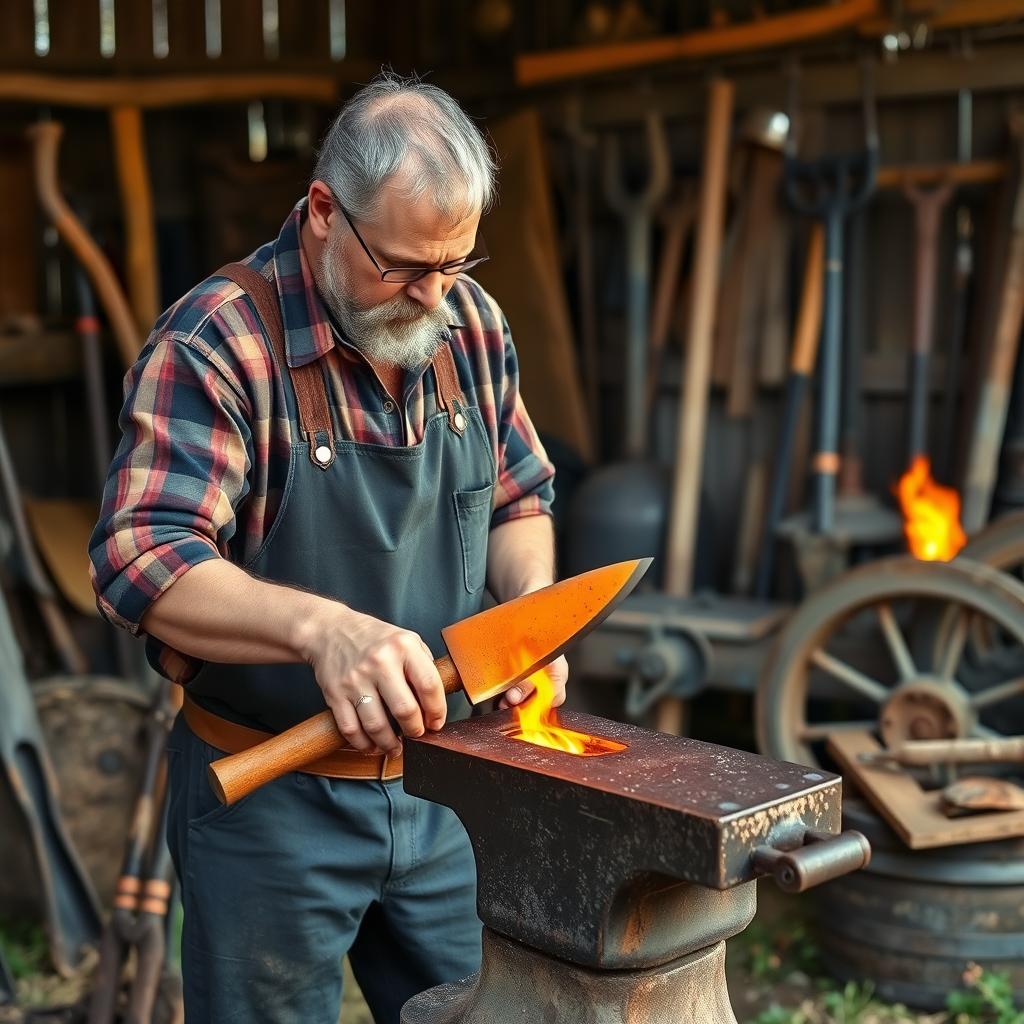
The rhythmic ping of hammer striking metal echoes across the landscape, a sound as old as civilization itself. Sweat beads on the brow of the craftsman as raw metal transforms—not in some distant factory, but right here on American soil, on farms where self-reliance isn’t just a philosophy but a practical necessity. This renaissance of ancient crafting techniques isn’t merely nostalgic reverence for the past—it’s a powerful economic and operational strategy reshaping modern agriculture from the ground up.
When Mike Dawson’s third mass-produced broadfork broke during spring planting—leaving him with a hefty replacement bill and precious lost time—he didn’t reach for his credit card. Instead, he reached back through time, tapping into knowledge that Roman farmers would have recognized two millennia ago. The result? A handcrafted tool that has now outlasted its factory-made predecessors by seven seasons and counting.
Across America, a quiet revolution is taking place as farmers rediscover what our ancestors understood intuitively: tools shaped by human hands, attuned to specific needs and conditions, simply work better. They last longer. They feel right. And perhaps most importantly in today’s economic climate, they represent a path to genuine self-sufficiency that no amount of outsourcing can provide.
This movement isn’t about rejecting modern farming practices wholesale. Rather, it’s about thoughtful integration of timeless wisdom with contemporary needs—creating a more resilient, adaptive, and ultimately sustainable approach to agriculture. The Romans, masters of practical innovation, would certainly approve.
The Hidden Costs of Modern Farm Equipment (And Why Romans Had It Right)
Walk into any agricultural supply store today, and you’ll find rows of shining implements promising efficiency and convenience. What’s less obvious is the hidden economy these tools create—one that flows steadily away from your farm and into corporate coffers through planned obsolescence, proprietary parts, and designs that prioritize manufacturing ease over longevity.
The Romans approached tool-making with fundamentally different priorities. For them, a farming implement represented a significant investment of resources and labor—one expected to serve not just for seasons but for generations. Roman tools weren’t designed to be replaced; they were designed to be repaired, maintained, and passed down. Archaeological discoveries routinely unearth Roman agricultural implements that remained in active use for centuries.
This durability wasn’t accidental. Roman blacksmiths understood metallurgy at a sophisticated level, creating tools with different hardness levels in different areas—flexible where needed, unyielding where strength was paramount. They customized handles to fit the user’s grip and adapted designs to specific soil conditions and crops. Each tool was an exercise in practical perfection, not mass production.
When we examine the economics of modern farming, the contrast becomes stark. A typical farm may spend thousands annually replacing broken or worn implements—tools designed with intentional weak points and made from materials selected for cost-efficiency rather than longevity. Meanwhile, a well-crafted hand-forged tool might cost more initially but often remains functional for decades with minimal maintenance.
The economic advantage compounds when we consider downtime. When a critical tool fails during a time-sensitive operation like planting or harvest, the cost isn’t just the replacement—it’s the potential crop loss, the emergency shipping fees, and the stress of improvising solutions. A blacksmith-farmer who can repair or recreate tools on-site eliminates this vulnerability entirely.

The Roman Blacksmith’s Advantage: Principles That Transcend Time
What makes Roman blacksmithing techniques so enduringly relevant? The answer lies not in some secret formula lost to time, but in fundamental principles that align perfectly with the needs of modern sustainable agriculture.
First among these principles is material awareness. Roman smiths didn’t have access to mass-spectrometry or computer modeling, but they developed intimate knowledge of how different metals behaved under various conditions. They understood that properly worked iron could hold an edge while remaining tough enough to withstand impact. They recognized that different tools required different material properties—flexibility for some applications, rigidity for others.
Modern farmers who adopt blacksmithing can apply this same principle, often with superior materials. Today’s high-carbon steels, when properly worked, can produce tools with performance characteristics that would amaze even the most skilled Roman artisan. The key is understanding which materials suit which applications—knowledge that comes through practice and direct engagement with the craft.
The second enduring principle is ergonomic customization. Roman tools weren’t designed for an abstract “average user”—they were made for specific individuals with specific body types working in specific conditions. This personalization didn’t just make tools more comfortable; it made them dramatically more efficient and less likely to cause injury with prolonged use.
For today’s farmer-blacksmith, this means creating implements precisely balanced for their own strength, reach, and working style. It means handles shaped to individual grips and cutting edges aligned to personal working angles. The result is tools that feel like natural extensions of the body rather than awkward external implements.
Perhaps most importantly, Roman blacksmithing embraced the principle of appropriate technology—tools sophisticated enough to accomplish their purpose efficiently but simple enough to be maintained and repaired with locally available resources. This approach creates a closed system where farmers maintain control over their own means of production rather than remaining dependent on distant supply chains.
Forging Your First Farm Tool: The Roman-Inspired Hoe
Among the most versatile and essential tools on any farm is the humble hoe—a implement the Romans elevated to an art form through regional variations and task-specific designs. Creating your own Roman-inspired hoe represents an ideal entry point into agricultural blacksmithing, requiring minimal specialized equipment while producing an immediately useful result.
The process begins with material selection. Traditional Roman hoes used wrought iron, but modern blacksmiths can achieve superior results with high-carbon steel—particularly old leaf springs from vehicles, which provide excellent material that has already been properly processed. This repurposing approach honors both Roman practicality and modern sustainability principles.
The basic form follows function: a blade with a socket or tang to attach the handle. Where Roman innovation shines is in the subtle variations—wider blades for moving soil, narrower ones for precision weeding, triangular shapes for creating seed furrows. Before beginning, consider what specific tasks your hoe will perform and shape your design accordingly.
The transformation begins with heat. Using a forge (which can be as simple as a propane torch for beginners or a traditional coal forge for the dedicated), the steel is heated until it reaches a bright orange-red color—approximately 1800°F—at which point it becomes malleable. This state, which blacksmiths call “plastic,” allows the metal to be shaped without cracking.
Working with hammer and anvil (or a suitable hard surface), the metal is drawn out to create the blade, folded to create the socket, and shaped to the desired profile. This process requires patience—working in stages, reheating as necessary, and allowing intuition to develop through practice. The Romans understood that metalworking is as much art as science, a dialogue between craftsman and material.
After achieving the basic shape, the critical process of hardening and tempering begins. The blade edge is heated to critical temperature (indicated by a cherry red color) and then quenched rapidly in water or oil. This creates extreme hardness but also brittleness. To balance these properties, the metal is then tempered—reheated to a lower temperature (usually indicated by color changes on the metal surface) and allowed to cool slowly, creating the perfect balance of hardness and toughness.
The final step involves fitting a handle—traditionally ash or hickory for their combination of strength and shock absorption. The Romans understood that the handle-to-head connection represented a potential failure point and developed sophisticated socketing techniques to ensure durability. Modern adaptations might include additional reinforcement with pins or epoxy while maintaining the essential mechanical principles.

The Blacksmith’s Trifecta: Three More Essential Farm Tools
Beyond the versatile hoe, three additional tools formed the cornerstone of Roman agricultural self-sufficiency—each offering distinctive benefits for the modern farmer-blacksmith.
The Roman billhook (falx) served as the multi-tool of ancient agriculture—part pruning knife, part brush clearer, part harvesting implement. Its curved blade with an inner cutting edge allowed for powerful controlled cuts with minimal effort. Creating your own begins with larger stock than the hoe requires—a section of car leaf spring approximately 12-14 inches long provides ideal material.
After heating, the distinctive curve is formed by hammering the heated metal against the rounded edge of the anvil (or equivalent surface). The cutting edge is established on the inner curve, then refined through careful filing and sharpening. The handle attachment uses a tang design—where an extension of the metal is inserted into a wooden handle and secured with pins. This design allows tremendous strength while permitting replacement of the handle if necessary.
The Romans recognized that different crops and conditions required variations in the basic design—more pronounced curves for woody materials, straighter profiles for grasses and grains. This adaptability represents one of the greatest advantages of creating your own tools—the ability to modify designs based on direct experience.
The Roman mattock combines aspects of both axe and adze, creating a versatile tool for breaking ground, removing roots, and shaping earth. Its two-sided design—typically with a horizontal adze blade on one side and a vertical pick on the other—makes it particularly valuable for initial field preparation and infrastructure work.
Crafting a mattock represents a more advanced project, requiring management of more material and the creation of a secure eye for the handle. The process begins with heavier stock—wagon axles or large vehicle springs provide suitable material. The eye (handle hole) is formed first, usually by punching and drifting (gradually enlarging) a hole in the heated metal, then the working ends are shaped through careful drawing and folding of the material.
Finally, the Roman pruning knife (falcula vineatica) represents the pinnacle of precision agricultural tools—small enough for detailed work but designed for all-day use without fatigue. Unlike modern pruners with moving parts that eventually fail, the Roman design achieves efficiency through perfect balance and ergonomics.
Creating your own pruning knife begins with smaller high-carbon steel—old files or rasps provide excellent material with the hardness necessary for maintaining a sharp edge. The blade is shaped while hot, then carefully hardened and tempered to create an edge that remains sharp through heavy use while resisting chipping or breaking.
Beyond Utility: The Cultural Renaissance of Farm Blacksmithing
When farmers rediscover the art of creating their own tools, something beyond mere economic advantage emerges—a profound reconnection with agricultural heritage that transforms the relationship between farmer, land, and work. This cultural dimension shouldn’t be dismissed as mere sentiment; it represents a powerful force shaping the future of sustainable agriculture.
Throughout history, blacksmiths held special status in agricultural communities—part craftsman, part engineer, part artist. Their knowledge was essential to community resilience, enabling adaptation to changing conditions through modification of existing tools or creation of new implements. When today’s farmers reclaim these skills, they’re not simply learning a craft—they’re revitalizing a knowledge tradition that underpinned agricultural communities for millennia.
This revival creates tangible connections across generations. Imagine working soil with a tool you’ve created using techniques that would be recognizable to farmers from ancient Rome through medieval Europe to early America. Each swing of that implement becomes a conversation with agricultural ancestors, a physical embodiment of accumulated wisdom transmitted through direct experience rather than abstract instruction.
Perhaps most significantly, tool-making transforms the farmer’s relationship with their equipment. Mass-produced implements remain perpetually external—things to be purchased, used, and discarded. Handcrafted tools become extensions of the maker’s intent and understanding, evolving through seasons of use and refinement. They carry stories, bear the marks of adaptation, and ultimately become vessels of personal agricultural philosophy.
This transformed relationship extends to the land itself. When tools are created specifically for particular soil conditions, crop requirements, and working methods, they enable more intimate and responsive interaction with the landscape. The farmer working with custom-made implements develops heightened sensitivity to subtle variations in terrain, moisture, and soil composition—information that guides sustainable decision-making.

Starting Your Roman-Inspired Blacksmithing Journey
The path to blacksmithing self-sufficiency doesn’t require massive investment or specialized facilities. Romans operated with remarkably simple equipment—evidence suggests many agricultural communities maintained basic forges requiring little more than a heat source, basic hammers, and a sturdy work surface.
For today’s beginning blacksmith, the essentials remain similarly accessible. A basic forge can be constructed from readily available materials—simple brake drum forges or propane-fueled designs offer entry points requiring minimal fabrication skills. Used anvils can often be found at reasonable prices, but in a pinch, a section of railroad track or heavy steel plate can serve the purpose for basic projects.
Tools to begin with include a cross-peen hammer (3-4 pounds is versatile for most farm projects), basic tongs for material handling, and quenching containers. Files, chisels, and punches round out the starter kit. All told, a functional beginner’s setup might represent an investment comparable to purchasing two or three quality manufactured farm implements—with the capacity to produce dozens of custom tools.
Knowledge acquisition follows a similar accessible approach. While formal blacksmithing classes offer accelerated learning, many successful farmer-blacksmiths are self-taught through a combination of books, online resources, and most importantly, deliberate practice. The basic physical principles of metalworking remain consistent regardless of historical period or geographic location—heat makes metal malleable, hammering changes its shape, controlled cooling affects its properties.
Safety considerations should never be overlooked. Proper eye protection, fire-resistant clothing, adequate ventilation, and basic fire safety measures are non-negotiable aspects of responsible blacksmithing. The Romans understood the hazards of their craft and developed protocols accordingly—modern practitioners should be equally conscientious.
Perhaps the most important principle for beginners is progressive complexity. Start with simple projects like the basic hoe described earlier, then gradually advance to more complex implements as skills and confidence develop. This approach mirrors how Roman apprentices would have learned—beginning with fundamental techniques before attempting more sophisticated work.
The Economics of Agricultural Self-Reliance
Beyond the romantic notion of connection to agricultural heritage lies a compelling economic case for farm blacksmithing. When analyzed across the lifespan of a farming operation, the financial advantages of tool self-sufficiency become increasingly apparent.
Consider the initial investment compared with ongoing commercial equipment purchases. A basic blacksmithing setup—forge, anvil, hammers, tongs, and safety equipment—might represent an investment of approximately $500-1500, depending on whether items are purchased new or sourced secondhand. This one-time expenditure enables the creation of dozens of specialized tools, each of which might cost $50-300 if purchased commercially.
More significant than the per-tool cost savings is the dramatic extension of tool lifespan. Commercial farming implements often follow predictable failure patterns, with handles separating from heads, welds breaking, or materials bending beyond repair. These failures typically occur at precisely the wrong moment—during critical seasonal operations when replacement causes maximum disruption.
Handcrafted tools using traditional techniques typically last 3-5 times longer than their commercial counterparts. When they do eventually require maintenance, repairs can be performed on-site, often using materials already available on the farm. This resilience translates directly into operational continuity and stress reduction during peak seasons.
Perhaps the most overlooked economic benefit lies in the customization potential. Commercial tools are designed for an imaginary “average” farm condition—a compromise that serves no one perfectly. Custom-crafted implements can address specific challenges unique to particular landscapes, soil types, or cropping systems. This precision translates into more efficient operations, reduced physical strain, and ultimately higher productivity.
For farms offering educational components or agritourism experiences, the blacksmithing element provides additional revenue diversification. Demonstrations, workshops, and custom tool sales can transform what begins as a practical skill into a complementary business stream—something the enterprising Romans would certainly have appreciated.
From Ancient Wisdom to Modern Innovation
The rediscovery of Roman blacksmithing techniques doesn’t confine farmers to ancient technology—rather, it provides a foundation for truly sustainable innovation. By understanding the fundamental principles of tool design and creation, today’s agricultural practitioners can develop implements perfectly suited to emerging challenges.
As climate patterns shift and resilience becomes increasingly crucial, the ability to rapidly prototype and modify equipment represents a significant adaptive advantage. When commercial supply chains falter or standard equipment proves inadequate for changing conditions, the farmer-blacksmith can respond with appropriate modifications or entirely new designs.
This innovative potential extends beyond traditional hand tools. The basic metallurgical knowledge acquired through blacksmithing transfers to maintenance and modification of modern farm equipment as well. Understanding how metals behave under stress, how to strengthen weak points, and how to replace proprietary parts with custom-fabricated alternatives creates a new level of equipment sovereignty.
Perhaps most importantly, the blacksmithing mindset—a blend of practicality, creativity, and resourcefulness—represents the essence of sustainable agriculture. It embodies the principle that farms should be productive systems capable of meeting their own needs rather than dependent nodes in global supply networks.
The Romans understood that agricultural resilience required both specialized knowledge and practical self-sufficiency. Their approach to tool-making reflected this integrated understanding—implements were designed not just for immediate utility but for long-term service with minimal external inputs. By reclaiming these principles, today’s farmers aren’t simply looking backward—they’re forging a more resilient agricultural future.
As you consider your farm’s tool needs and long-term sustainability, remember that every stroke of the blacksmith’s hammer represents both connection to agricultural heritage and investment in future resilience. The skills that served Roman farmers for centuries remain equally valuable today—perhaps even more so in an era of increasing uncertainty and standardization.
The path to agricultural self-reliance begins with a single tool, shaped by your own hands for your specific needs. In that creation lies not just practical utility but a profound statement about the kind of farming future you choose to create—one built on knowledge, skill, and direct connection to the fundamental technologies that have sustained agriculture since its beginnings.


